So here is the latest update!!
Thursday, November 29, 2007
Well, we are still here! But we have been very busy on site hence the lack of blog news. This year we have worked on some brilliant projects, most of which we are now writing up in the warm (ish) office.
So here is the latest update!!
Coffin Works
The majority of the work required the cataloguing of boxes and boxes of coffin fittings such as breast plates, handles and coffin screws. However there were some more unusual finds such as the book of Masonic rituals, the funeral shroud in Aston Villa colours and a number of body-bags (presumably unused).
Wonderful Wednesbury
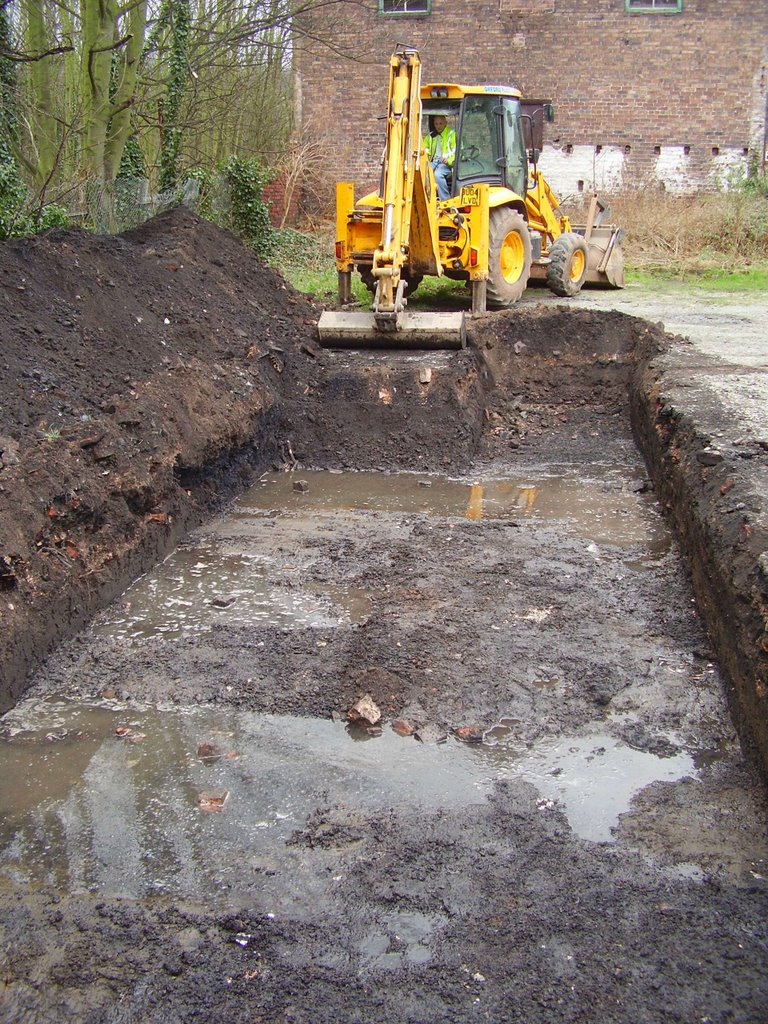
Since uncovering the first timber wheel race (Wheel Race 1) way back in March, and despite the very wet summer, we have found three more! Further excavation of Wheel Race 1 revealed the curved base of the wheel pit and friction marks on the side planks suggests the water wheel would have been around 4m in diameter. Fragments of the water wheel buckets were also discovered in the fill of the wheel pit.


Three additional wheel races were found to the south of Wheel Race 1, two of which sat directly beneath the later brick culverts. Wheel Race 2 was the longest surviving example consisting of two channels side by side. Like Wheel Race 1, this was constructed from oak, with a base frame, uprights and clay lined side boards. Mortice and tenon joints had been used to hold the structure together and some of the timbers bore the original carpenters marks in roman numerals.

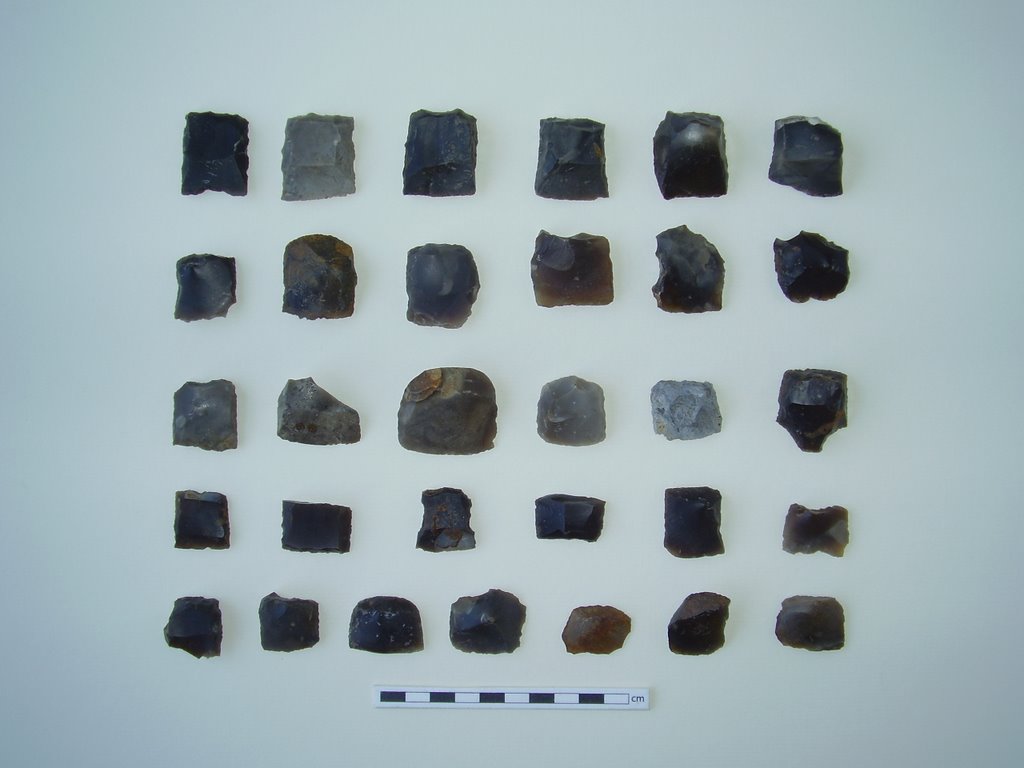
We have since removed the timbers and they have been dated to the late 16th - 17th centuries and represent the earliest phase of the sites development. There have also been numerous small finds, including pottery, leather shoes, iron nails, a pewter spoon, gun barrels, many more gun flints, several coins, including a George II halfpenny, dated 1752 and a token dated 1788 – issued by John Wilkinson the Ironmaster.
Three additional wheel races were found to the south of Wheel Race 1, two of which sat directly beneath the later brick culverts. Wheel Race 2 was the longest surviving example consisting of two channels side by side. Like Wheel Race 1, this was constructed from oak, with a base frame, uprights and clay lined side boards. Mortice and tenon joints had been used to hold the structure together and some of the timbers bore the original carpenters marks in roman numerals.
We have since removed the timbers and they have been dated to the late 16th - 17th centuries and represent the earliest phase of the sites development. There have also been numerous small finds, including pottery, leather shoes, iron nails, a pewter spoon, gun barrels, many more gun flints, several coins, including a George II halfpenny, dated 1752 and a token dated 1788 – issued by John Wilkinson the Ironmaster.
Glenfield Railway Tunnel
September saw most of the team underground in Leicester, carrying out a photographic survey of the Glenfield Railway Tunnel prior to strengthening works.
The tunnel measures 1 mile and 36 yards long and originally formed part of the Leicester-Swannington Railway which was officially opened on July 13th 1832. It was the longest tunnel of its type in England when it was opened and formed part of the first locomotive railway in the East Midlands. The building of the railway was fuelled by the need to enable the collieries of the area to transport coal to the markets in Leicester though it was soon over taken by the Midland Railway Company and carried passengers until the 1920’s.
The archaeological work involved taking a full photographic record of the tunnels length, and recording in more detail areas that had undergone repairs or that revealed evidence of construction techniques.
Lapley Court
In the spring of this year we carried out a geophysical and EDM survey of the gardens surrounding a timber framed cruck building – Lapley Court - in the hope that additional bays of the cruck frame were surviving under the lawn. This appeared not to be the case, but the vaulted roof of a Victorian water tank was discovered and trial trenching exposed many pottery finds, including one sherd of Black Burnished Ware!
An additional box framed extension forms part of the site, which has received planning permission to be reinstated using traditional materials and techniques. We have been recording the framing prior to dismantling, as well as recording the original cruck framed structure.
Recording of the timber framing continues and has so far exposed some interesting details – including evidence of trestle sawing, whereby timbers were cut from the end, towards the middle, and then turned around on the trestle and worked from the other end. This created saw marks running at 45 degree angles and a triangular shaped ‘snap off’ point where the lines meet. This may date the cruck frame to the 16th century or possible even earlier.
Coalport Bridge
During a brief dry and warm period in August, we carried out a small excavation and watching brief at Coalport Bridge. This involved digging two small drainage trenches and it was anticipated that some early evidence of the bridges construction would be uncovered. The bridge was first constructed from timber, with stone abutments in 1780 and was then called the Preens Eddy Bridge though during a flood in 1795, the middle pier of the bridge was severely damaged and the design and construction was reconsidered altogether.
A second bridge was constructed c.1800-1818, being made of cast iron and timber and involved the redesign of the bridge to become just one arched span, (the original bridge having had two spans). Finally, in 1818, the bridge was completely replaced with cast iron and this design can still be seen today with addition of minor alterations and repairs.
Unfortunately, any evidence relating to the bridges construction was not discovered, although many finds associated with the nearby Woodbridge Inn were plentiful.
Thursday, March 08, 2007
Timber-framed wheelpit and tailrace
The final push of excavations at Wednesbury has revealed a timber-framed tailrace. This is similar in construction to excavated examples from medieval and later sites, with a timber base, into which are slotted timber uprights ('studs'). Planking is secured to the outer and inner faces of the studs to ensure a smooth flow of water within the wheelpit and tailrace.
View of the wheel pit before excavation. The clay packing around the outside has been removed; pressure on the pit had caused it to collapse.
The wheelpit and tailrace probably date to the sixteenth century, although they may be earlier. Finds excavated so far suggest that it went out of use in the seventeenth century.
These brick structures overlie another series of substantial timbers which form part of the sixteenth century forge.
Work will continue on the site until Easter.
The wheelpit and tailrace probably date to the sixteenth century, although they may be earlier. Finds excavated so far suggest that it went out of use in the seventeenth century.
Work will continue on the site until Easter.
Monday, February 12, 2007
Finds from Bridgnorth
Whilst the snow and rain have been driving down outside, post-excavation work for the Bridgnorth evaluation has been going on inside. Here is a selection of some of the finds...
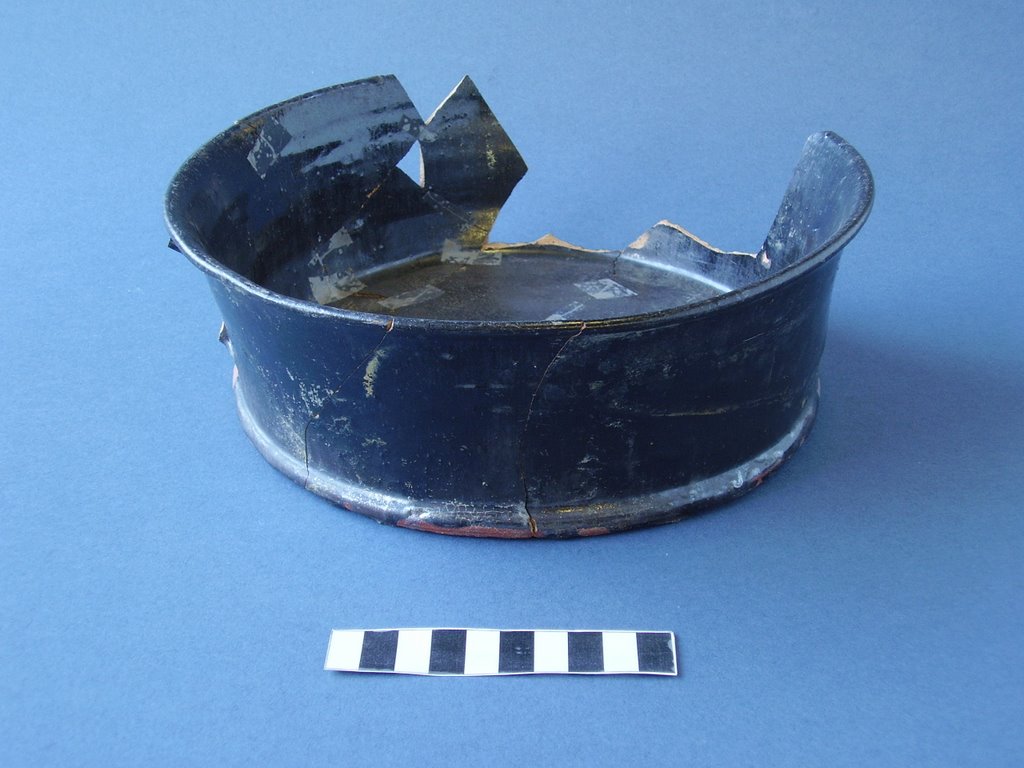
A rather gaudy selection showing the wide range of ceramics dumped in the river bylet.
Some lovely late 17th century slipware.
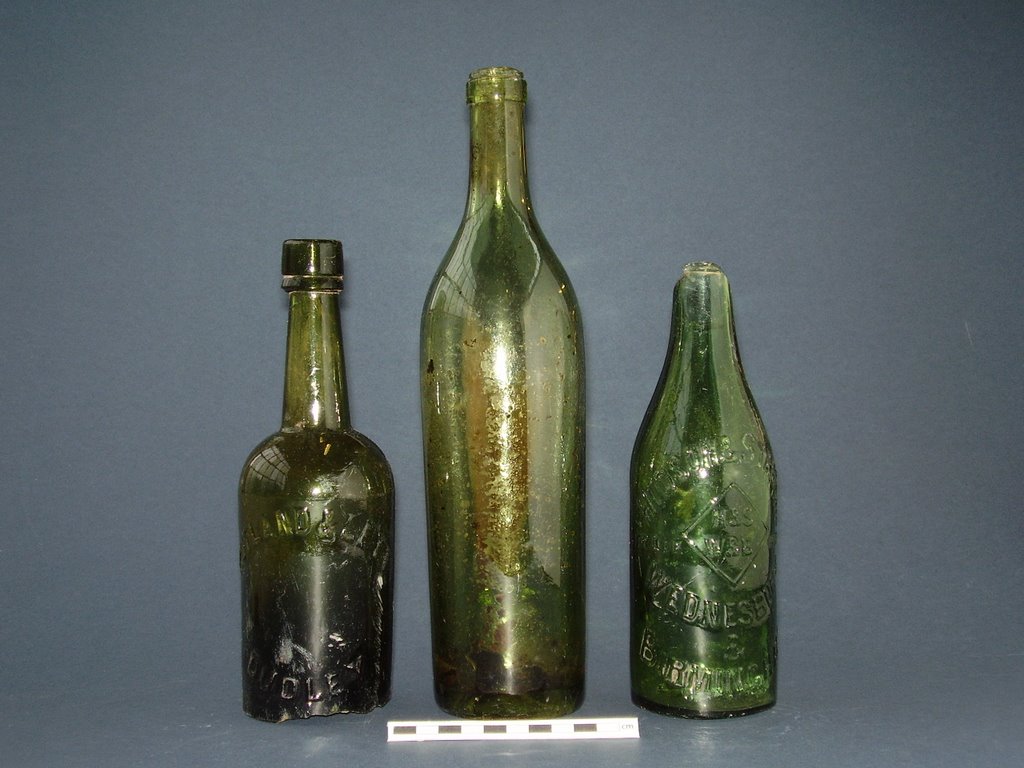
A selection of 19th century glass bottles, including Wollstein, Ironbridge (centre).
Malthouse drying floor tiles, 19th century. The '4-hole' design to the rear is probably the earliest.
Maws 'sandwich' encaustic tile, dated to between 1860 and 1870 and made at their works in Benthall.
The back of the tile - confirming the date range before the move to their Jackfield works in 1883.
Many thanks to Dr. Tony Herbert and Michael Vanns for information on the Maws Tile.
Friday, February 09, 2007
More snow
As promised, here are some more pictures of Coalbrookdale and Ironbridge in the snow. These photos were taken on Thursday...
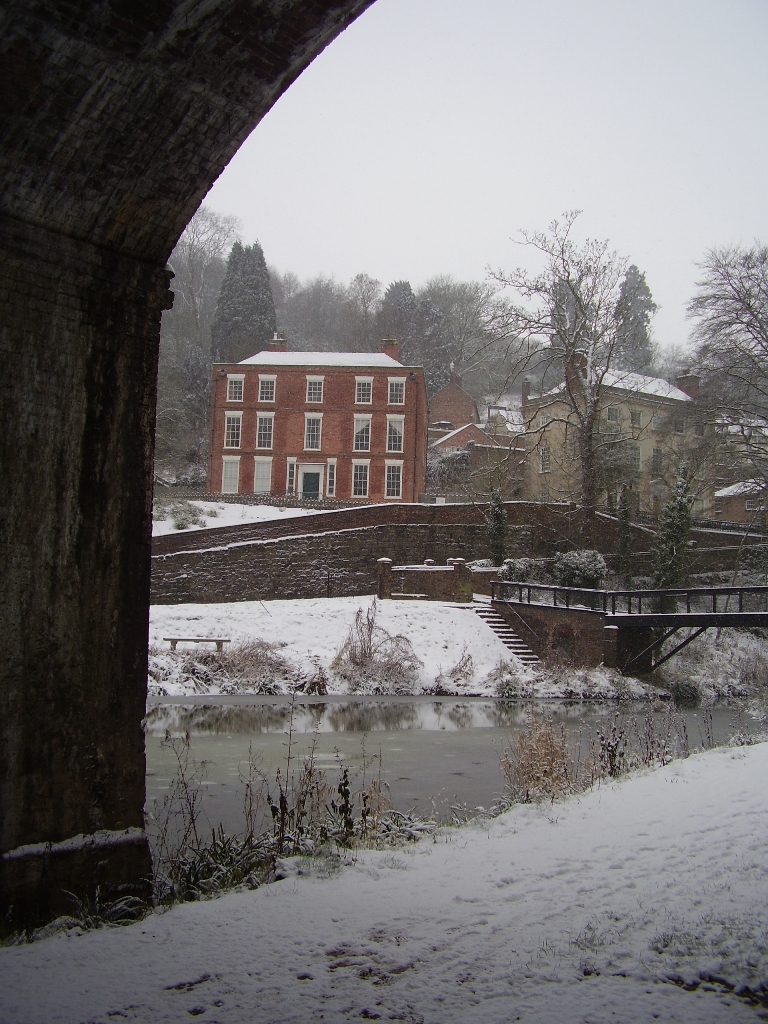
Dale House (left) and Rosehill House, built by the Darby family in the early 18th century, and overlooking the Upper Furnace Pool. The arch in the foreground is part of the railway viaduct of 1864.
Unusual view across the Upper Furnace Pool, with the top of the furnace cover building peeping up above the dam wall.
View through the trees on towards the Great Warehouse (Museum of Iron).
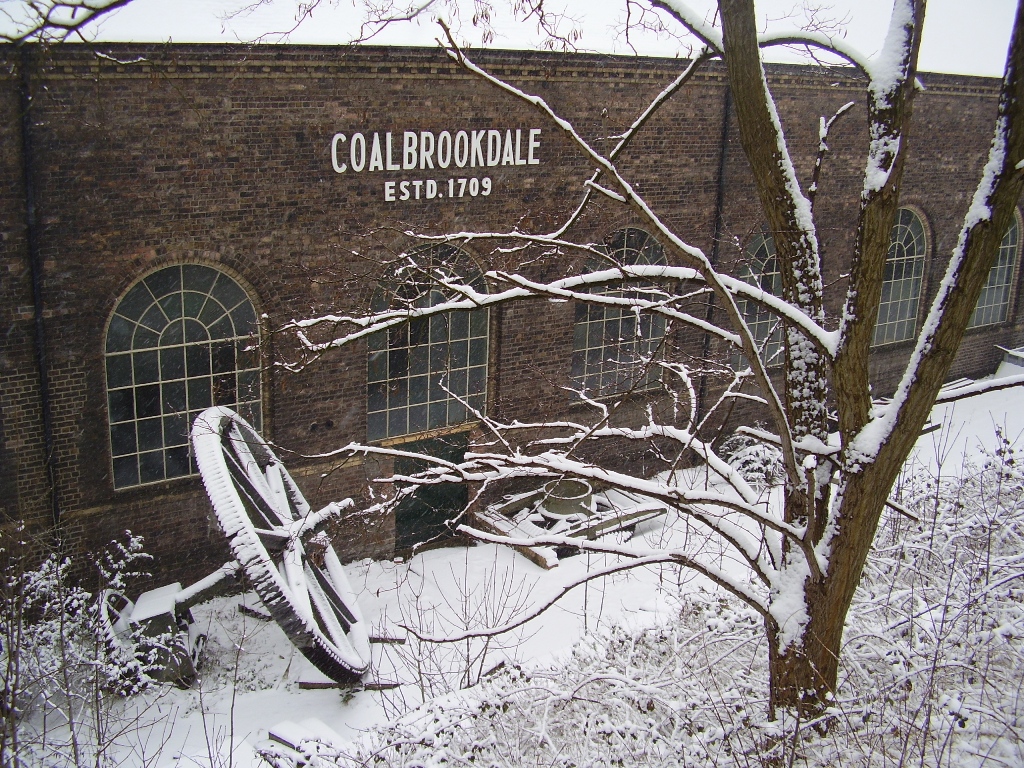
Established 298 years ago. The giant wheel is part of the Godalming Water Turbine.
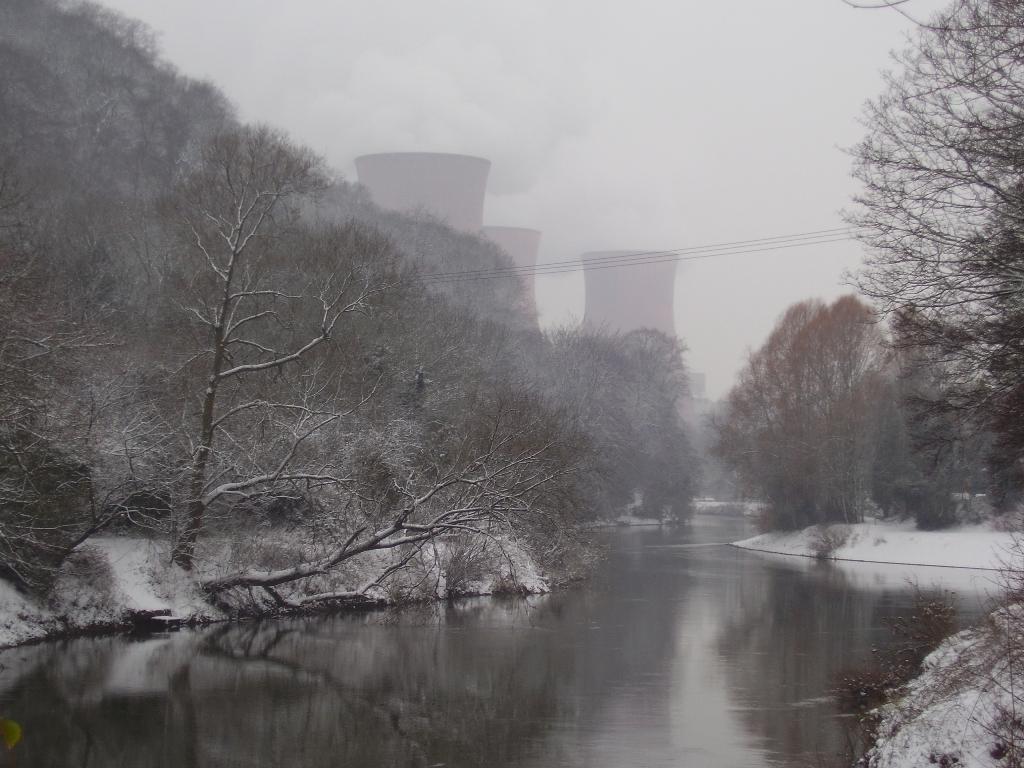
View upriver with the Ironbridge power station looming in the distance.
The Iron Bridge, looking upstream from Severn Bank.
Cottages on the north bank of the River.
Dale House (left) and Rosehill House, built by the Darby family in the early 18th century, and overlooking the Upper Furnace Pool. The arch in the foreground is part of the railway viaduct of 1864.
Unusual view across the Upper Furnace Pool, with the top of the furnace cover building peeping up above the dam wall.
View through the trees on towards the Great Warehouse (Museum of Iron).
Established 298 years ago. The giant wheel is part of the Godalming Water Turbine.
View upriver with the Ironbridge power station looming in the distance.Thursday, February 08, 2007
Snow
The widely-forecast snow has actually arrived. So here are some photographs of some of the Museum's buildings and monuments in the snow...
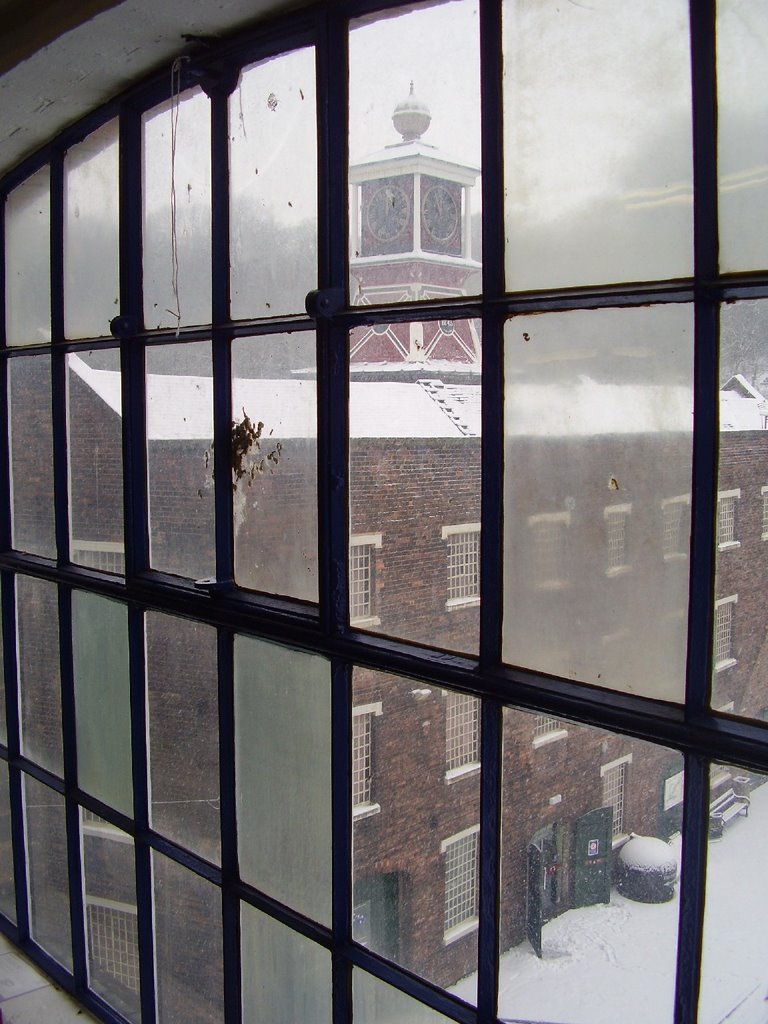
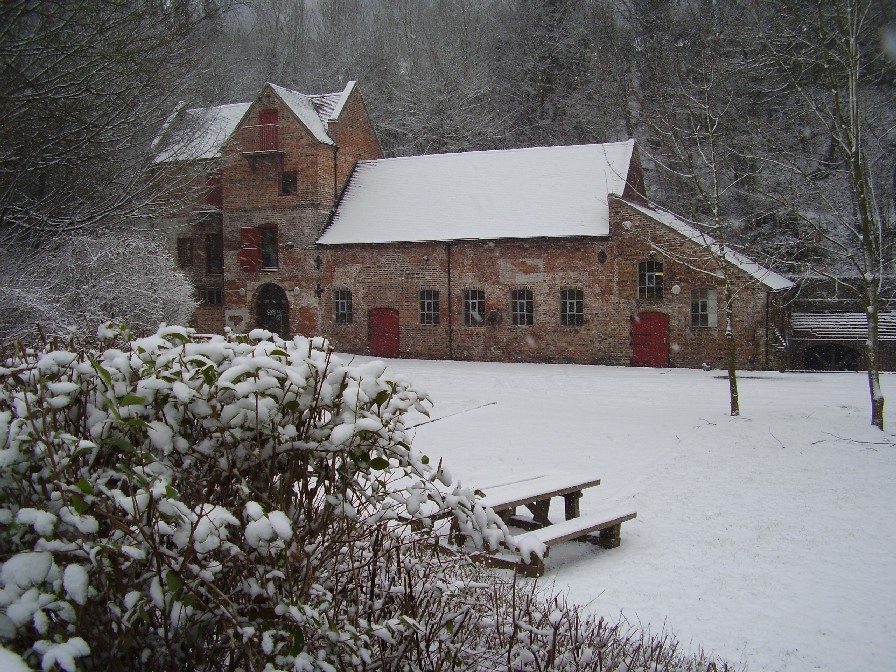
View from the archaeology office window in the Long Warehouse. Outside is the 'Great Warehouse' of the Coalbrookdale Company, now the Museum of Iron. The warehouse was built in 1838 and the clock tower was added in 1843.
The Upper Forge was in use from the 16th and 17th centuries. These surviving buildings are 18th century.
The recently-restored overflow sluices from the former Upper Forge Pool.
Rose Cottage, near the site of the former Middle Forge. The cottages were built in the 1640s.
It is still snowing now (late morning), so more photos will be taken this afternoon and will no doubt appear here in due course.
View from the archaeology office window in the Long Warehouse. Outside is the 'Great Warehouse' of the Coalbrookdale Company, now the Museum of Iron. The warehouse was built in 1838 and the clock tower was added in 1843.
The Upper Forge was in use from the 16th and 17th centuries. These surviving buildings are 18th century.
The recently-restored overflow sluices from the former Upper Forge Pool.
Rose Cottage, near the site of the former Middle Forge. The cottages were built in the 1640s.It is still snowing now (late morning), so more photos will be taken this afternoon and will no doubt appear here in due course.
Wednesday, February 07, 2007
Darby Furnace Beam
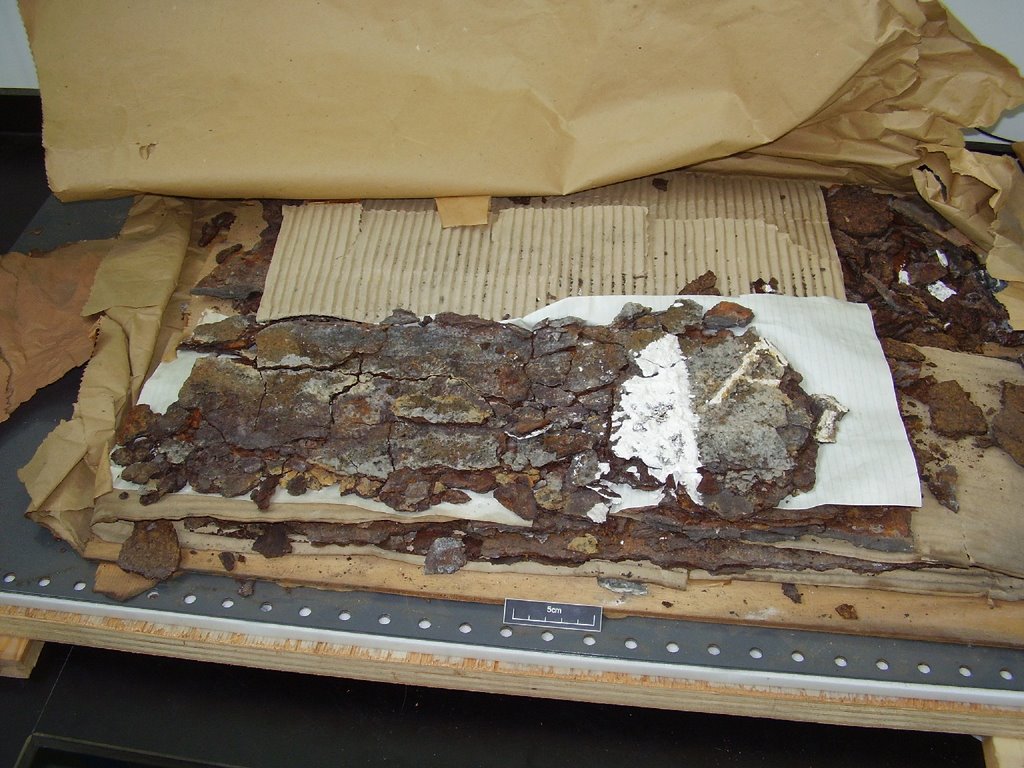
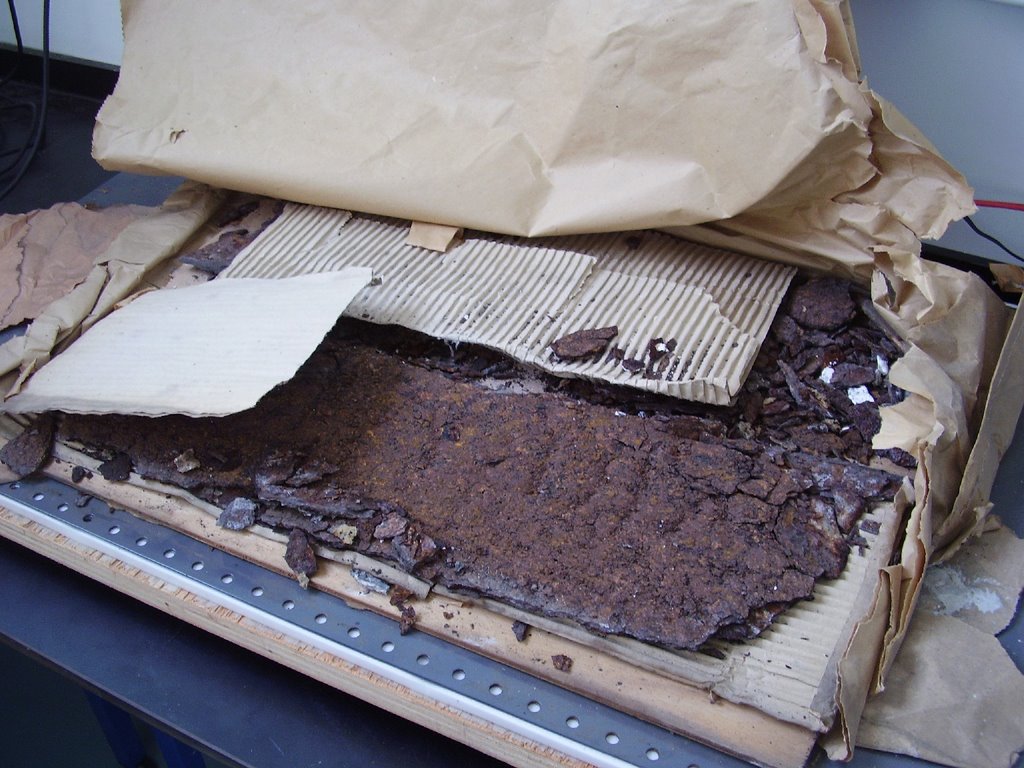
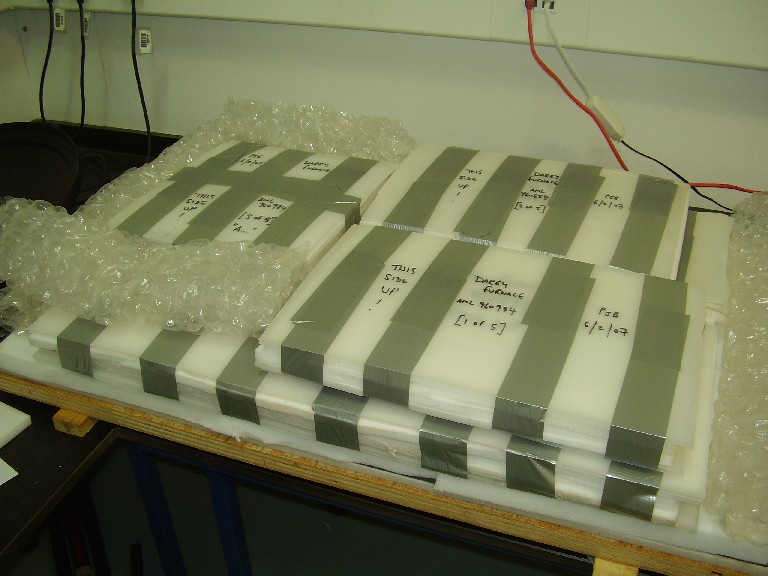
In 1972 the outer lamination of one of the beams to the Darby Furnace was in a poor state of repair and was 'rescued'. It was taken to the then Ancient Monuments Laboratory (AML) of the Department of the Environment (Ministry of Works). The former AML is now the English Heritage Centre for Archaeology, and is situated at Fort Cumberland in Portsmouth.
During a recent clear-out the box containing the beam fragments was discovered. This week Paul went down to collect the remains and repatriate them! Due to their fragile nature a full photographic record was made of all of the bits.
Not a promising start - rather tired packaging full of rust!
...and more rust!
Rather fragmented slice of metal, but is that an 'A' at the end?
and then we have a '...BRAHAM'
and finally a 'DARBY 1777' came out of the box!
The fragments were carefully repacked before being driven 'home' to Ironbridge...
Slightly more modern materials used, and carefully wedged together!
Many thanks to Justine Bayley, Vanessa Fell and the staff at the Centre for Archaeology in Portsmouth.
During a recent clear-out the box containing the beam fragments was discovered. This week Paul went down to collect the remains and repatriate them! Due to their fragile nature a full photographic record was made of all of the bits.
Not a promising start - rather tired packaging full of rust!
...and more rust!
Rather fragmented slice of metal, but is that an 'A' at the end?
and then we have a '...BRAHAM'
and finally a 'DARBY 1777' came out of the box!The fragments were carefully repacked before being driven 'home' to Ironbridge...
Slightly more modern materials used, and carefully wedged together!Many thanks to Justine Bayley, Vanessa Fell and the staff at the Centre for Archaeology in Portsmouth.
Wednesday, January 31, 2007
Excavations at Bridgnorth
After the problems with flooding a couple of weeks ago the river levels have now dropped and so we have been able to get on with work. The main aim of the trench has been to try and find the line of a former bylet. We were successful in locating the eastern edge of this feature, which was marked by a revetment wall.
Keith recording the trench section. He is standing on the line of the former bylet, with the revetment wall in the foreground.
The wall itself is made of sandstone blocks, which are ashlared on the western (river front) side. However the wall has also been given a front facing of brickwork which protects the relatively soft stone from erosion. The brick facing is quite late, but we have recovered an earlier brick from the core of the wall.
Detail of the wall const- ruction, from the river side.
We have found a wide range of artefacts, including nineteenth century bottles and drying floor tiles from the period when the site was in use as a malthouse. We have also recovered a number of earlier pieces, including seventeenth century slipware and tin-glazed earthenware. Photos of the finds will be posted once cleaning and cataloguing is completed.
Keith recording the trench section. He is standing on the line of the former bylet, with the revetment wall in the foreground. The wall itself is made of sandstone blocks, which are ashlared on the western (river front) side. However the wall has also been given a front facing of brickwork which protects the relatively soft stone from erosion. The brick facing is quite late, but we have recovered an earlier brick from the core of the wall.
Detail of the wall const- ruction, from the river side.We have found a wide range of artefacts, including nineteenth century bottles and drying floor tiles from the period when the site was in use as a malthouse. We have also recovered a number of earlier pieces, including seventeenth century slipware and tin-glazed earthenware. Photos of the finds will be posted once cleaning and cataloguing is completed.
Monday, January 29, 2007
The End
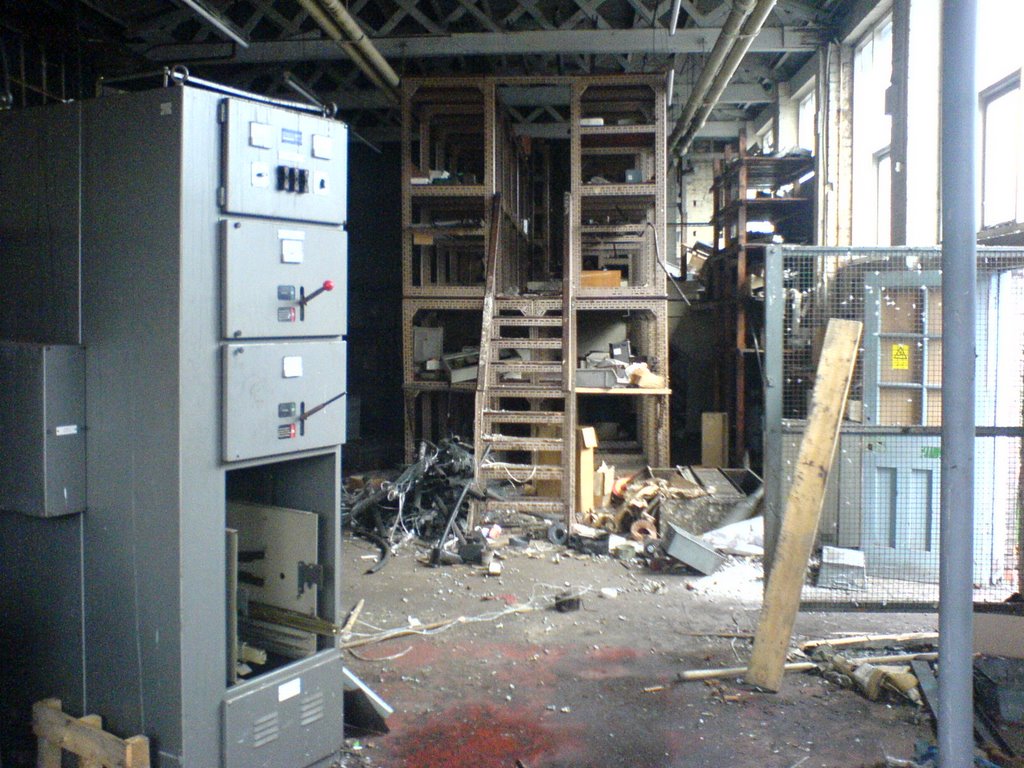
Sad scenes on site at Wednesbury Forge as the final stage of demolition of the upstanding structures is nearing completion. These are mainly twentieth century buildings, but still containing memories of high-quality English manufacturing industry. Having come to know the site well over the last five years, it is heart-breaking to see the once fastidiously clean managers' offices being pulled apart and thrown on the bonfire by demolition workers.
Plant room to the tool shop, during demolition.
Posters advertising quality on the wall of the former conference room.
Foundation stone laid by Edward Elwell, saved from the crusher.
Plant room to the tool shop, during demolition.
Posters advertising quality on the wall of the former conference room.
Foundation stone laid by Edward Elwell, saved from the crusher.
Monday, January 15, 2007
Flooding at Bridgnorth
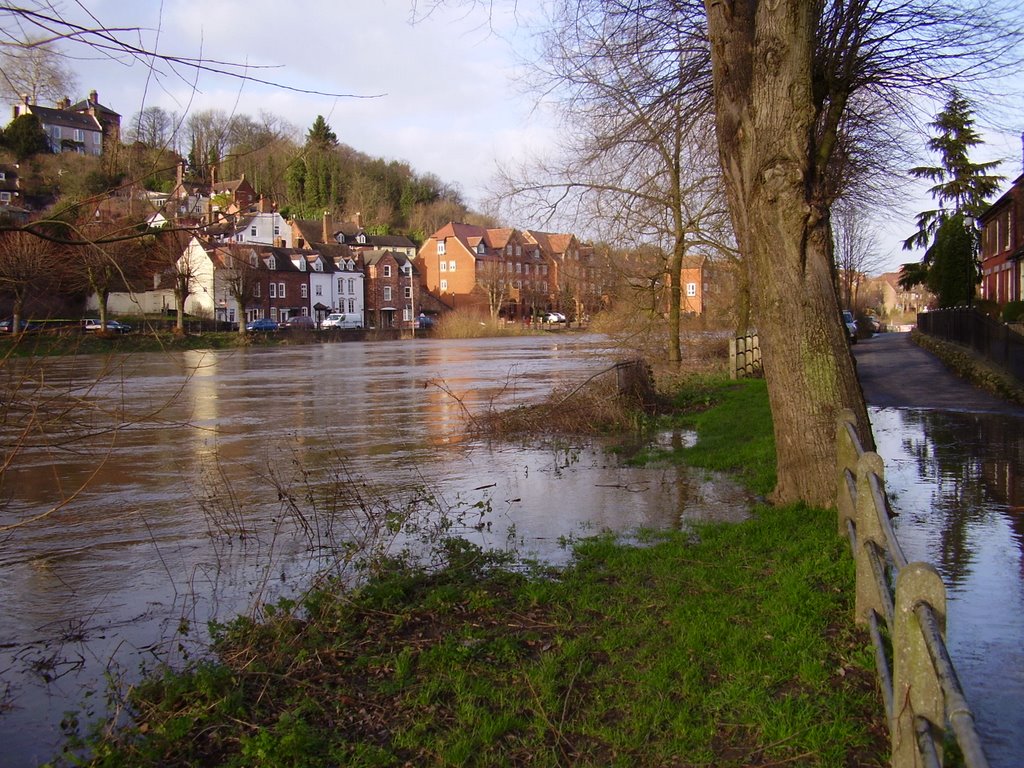
Work has started today on our evaluation in Bridgnorth. The main objective is to locate a 'bylet' - a small subsidiary channel of the River Severn. This may have medieval origins, and was certainly present for most of the post-medieval period. However recent rain has resulted in high water levels which have made progress somewhat difficult. Last week the floodwaters were very high so we postponed opening the trench until this week.
The site backs onto the river, and water levels were still rising when this photo was taken last week...
However despite a couple of dry days the water has been slow to recede. Part of the problem is that the relict reiver channel we are looking for will of course hold water for much longer than the surrounding landscape.
Water seeping up through the trench. So far we have only removed rubble layers tipped in the 1960s.
We have decided to postpone the work for another week in the hope that the river levels fall further. At present there is no point pumping out the excavation as it would re-flood very quickly.
The site backs onto the river, and water levels were still rising when this photo was taken last week...However despite a couple of dry days the water has been slow to recede. Part of the problem is that the relict reiver channel we are looking for will of course hold water for much longer than the surrounding landscape.
Water seeping up through the trench. So far we have only removed rubble layers tipped in the 1960s.We have decided to postpone the work for another week in the hope that the river levels fall further. At present there is no point pumping out the excavation as it would re-flood very quickly.
Friday, January 12, 2007
Happy New Year
Well 2007 has already kicked off to an exciting start with projects up and coming from all directions. This includes new building recording and excavation projects in the west midlands region and further afield, plus more work in the Ironbridge Gorge, the continuation of excavations at Wednesbury - and further research projects in Coalbrookdale. In addition we will be launching our new monograph series, featuring a series of important metallurgical and ceramic production sites.
Malthouse tiles recovered from excavations in Coalbrook- dale.
Watch this space for further updates!
Malthouse tiles recovered from excavations in Coalbrook- dale.Watch this space for further updates!
Wednesday, December 20, 2006
MERRY CHRISTMAS
A very Merry Christmas to everyone, and best wishes for 2007!
Snow falling over the Darby Furnace, as a coal train passes on the viaduct.
Some more photos of Coalbrookdale in the snow can be found in an earlier post. This one is a bit of a cheat, as it was taken in March 2006 so it does not represent current weather conditions! Although it has been very foggy lately, and this morning (20th December) it was in fact minus one and frosty, snow looks pretty unlikely this year!
Snow falling over the Darby Furnace, as a coal train passes on the viaduct.Some more photos of Coalbrookdale in the snow can be found in an earlier post. This one is a bit of a cheat, as it was taken in March 2006 so it does not represent current weather conditions! Although it has been very foggy lately, and this morning (20th December) it was in fact minus one and frosty, snow looks pretty unlikely this year!
Monday, December 11, 2006
New buildings at Jackfield
Part of the development of the Jackfield Tile Museum has involved the demolition of late twentieth century foundry buildings and their replacement with early twenty-first century 'arts' buildings. Part of this new structure overlies the old kiln which we discovered in September last year (see earlier post on the subject).
Looking through the entrance archway the new building looms into sight. Deliberately 'new' in contrast to the existing structures, and echoing the footprint and roofline of the buildings it replaces.
The new building contains arts and crafts workshops let out to various tenants, and the upper floor will contain a gallery.
Looking through the entrance archway the new building looms into sight. Deliberately 'new' in contrast to the existing structures, and echoing the footprint and roofline of the buildings it replaces.The new building contains arts and crafts workshops let out to various tenants, and the upper floor will contain a gallery.
Wednesday, November 29, 2006
Ditherington Flax Mill
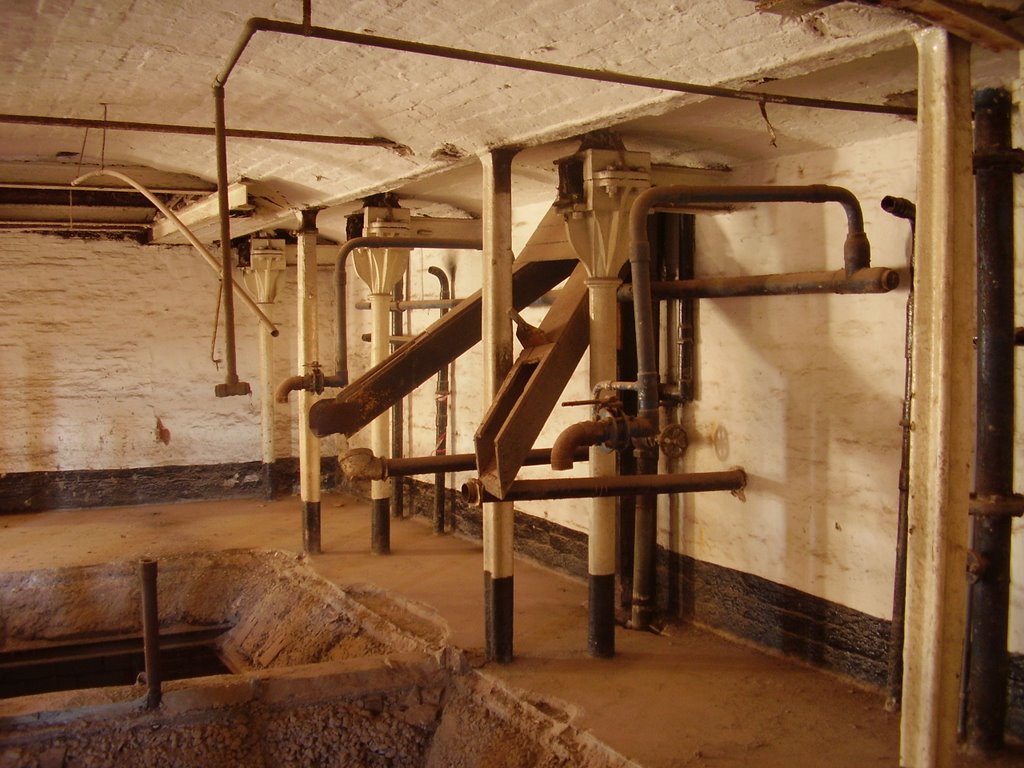
Further recording at Ditherington Flax Mill has been ongoing on behalf of English Heritage. Structural repair to the main mill is being accompanied by ongoing archaeological recording. This has enabled us to have a good look at many of the later features associated with the conversion of the building to a maltings in the nineteenth century.
Hoppers and chutes for moving grain around the maltings.
Thursday, November 23, 2006
Finds from Wednesbury Forge
The 2006 phase of excavation work at Wednesbury Forge has now finished. Further work will take place on site next year once the remaining buildings on site have been demolished. The team are now hard at work back in the office processing the finds from the project. Here is a selection of some of the material which we have recovered...
Eighteenth century gunflints.
Eighteenth century earthen- ware.
Local nineteenth century bottles
Nineteenth century scissors.
Twentieth century bowling ball (marked 'EAC' - Elwell's Athletic Club)
For more information about the site please scroll down for earlier posts.
Eighteenth century gunflints.
Eighteenth century earthen- ware.
Local nineteenth century bottles
Nineteenth century scissors.
Twentieth century bowling ball (marked 'EAC' - Elwell's Athletic Club)For more information about the site please scroll down for earlier posts.
Tuesday, November 14, 2006
CHAT conference
Past and present members of the Ironbridge Archaeology team were out in force at the CHAT conference in Bristol. A more comprehensive impression of the conference will shortly be posted on our contemporary archaeology blog.
Saturday saw the presentation by William Mitchell and Emma Dwyer of a paper on the work we have been doing at Wednesbury Forge, and specifically the issues raised in attempting to record contemporary social archaeologies. As with Jim Dixon's paper we were trying to present the perspective of contracting archaeology within an overwhelmingly university-led conference.
Star of the series of films on Saturday night was of course the Archaeology Van. This was the first showing of the film by Greg Bailey, following the project by the University of Bristol in excavating the van. The film raised a great deal of comment, and will also be shown at the forthcoming TAG conference in Exeter.
Saturday saw the presentation by William Mitchell and Emma Dwyer of a paper on the work we have been doing at Wednesbury Forge, and specifically the issues raised in attempting to record contemporary social archaeologies. As with Jim Dixon's paper we were trying to present the perspective of contracting archaeology within an overwhelmingly university-led conference.
Star of the series of films on Saturday night was of course the Archaeology Van. This was the first showing of the film by Greg Bailey, following the project by the University of Bristol in excavating the van. The film raised a great deal of comment, and will also be shown at the forthcoming TAG conference in Exeter.
Friday, November 03, 2006
Whitehaven Collieries
Whitehaven is a seventeenth century planned harbour town in Cumbria, and was the focus of a wide range of mining and related activities in the eighteenth, nineteenth and twentieth centuries. We have been working with Cranstone Consultants on an assessment of various landscape features on behalf of the National Trust. Here is a selection of photographs of some of the colliery features we have been investigating with David Cranstone.
View looking north from the area of Wellington Pit.
Pit head winding gear at Haig Colliery, looking south.
Saltom Pit, looking west over the sea.
Looking up the incline near Kells, facing south.
View looking north from the area of Wellington Pit.
Pit head winding gear at Haig Colliery, looking south.
Saltom Pit, looking west over the sea.
Looking up the incline near Kells, facing south.
Tuesday, October 31, 2006
Wellington (Shropshire)
The watching brief that we started in Wellington in September has now been completed. The site, near Limekiln Lane, was the former home farm of the Old Hall, which itself lies outside of the development area. The surviving farm buildings consist of a 17th century timber framed barn and a fragment of a threshing barn dating to the late 18th century.
General view of the site with the timber-framed barn in the back- ground.
Despite the long history of occupation on the site there was little in the way of archaeological remains. A series of levelling layers represented improvements to the farm yard area, but no datable finds were recovered and unfortunately little new light has been shed on the development of this site.
General view of the site with the timber-framed barn in the back- ground.Despite the long history of occupation on the site there was little in the way of archaeological remains. A series of levelling layers represented improvements to the farm yard area, but no datable finds were recovered and unfortunately little new light has been shed on the development of this site.
Friday, October 27, 2006
Workhouse Coppice
Work continues at Workhouse Coppice in the Ironbridge Gorge on behalf of the Severn Gorge Countryside Trust. We started work here in July 2006, when we carried out an assessment as part of the SGCT's management review. The assessment comprised desk based research and a comprehensive walkover survey of the site. The research and survey identified numerous remains of mining and other industrial activities within the coppice dating to the 17th, 18th and 19th centuries.
Surface remains of a bell pit.
We have been monitoring the construction of new access routes and recording features that have been affected by them. This project will be continuing into the winter.
Surface remains of a bell pit.We have been monitoring the construction of new access routes and recording features that have been affected by them. This project will be continuing into the winter.
Wednesday, October 11, 2006
The Iron Bridge
Following our extensive work on various aspects of the Iron Bridge in 1999-2000 and 2001-2002, we have returned to the site as part an investigation of the bridge road surface by English Heritage. There are concerns that the penetration of water through the road surface is affecting the deck plates. A series of small trial holes were excavated at various points along the road surface to examine the structure.
This photo shows the overall surface of the bridge. The red wooden squares mark the location of the holes.
The bridge carries a number of services, including gas, water, electricity and telephone, which may be serving to draw water along the bridge - accelerating corrosion. The deck plates are laid across the bridge and support the road surface. The excavations revealed a series of former road surface layers.
The deck plates themselves are of two types. The original plates, on the main span of 1779, were cast as flat sheets without flanges. Thus water is able to escape between the plates. On the two later (1820s) spans the deck-plates were cast with flanges approximately 50mm high, presumably to ensure a stiffer and more easily-handled casting. Due to the slope of the bridge these catch and hold water, causing corrosion to the downhill sides of the deck plates.
1779 deck plate. The cast-iron kerb dates from the 1920s and will be removed during future re- surfacing.
Join between 1820s deck plates, showing accum- ulation of water against the flange.
This photo shows the overall surface of the bridge. The red wooden squares mark the location of the holes.The bridge carries a number of services, including gas, water, electricity and telephone, which may be serving to draw water along the bridge - accelerating corrosion. The deck plates are laid across the bridge and support the road surface. The excavations revealed a series of former road surface layers.
The deck plates themselves are of two types. The original plates, on the main span of 1779, were cast as flat sheets without flanges. Thus water is able to escape between the plates. On the two later (1820s) spans the deck-plates were cast with flanges approximately 50mm high, presumably to ensure a stiffer and more easily-handled casting. Due to the slope of the bridge these catch and hold water, causing corrosion to the downhill sides of the deck plates.
1779 deck plate. The cast-iron kerb dates from the 1920s and will be removed during future re- surfacing.
Join between 1820s deck plates, showing accum- ulation of water against the flange.
Wednesday, October 04, 2006
Industrial Archaeology?
The EAA conference in Cracow was extremely interesting, with a number of important sessions reflecting the currently very dynamic state of European archaeology. The session hosted by Kenny Aitchison and Mark Spanjer on the effectiveness of implementation of the Valetta Convention was particularly good. Both the papers and subsequent discussion drew attention to the vast differences between the 'Anglo-Saxon' model of privatised commercial archaeology as exemplified by the UK, and the central-eastern European model of state-funded Museum-focused archaeology. With of course a wide range of other approaches - such as those of the French - in between.
Cracow is an extremely beautiful and pleasant city and well worth a visit.
A rather more grim aspect of European history was presented at Auschwitz-Birkenau, the most notorious of the Nazi death camps. The mechanisation of the process of genocide was striking, and the scale of what had happened was extremely moving.
Factory of death.
Railway sidings.
Cracow is an extremely beautiful and pleasant city and well worth a visit.
A rather more grim aspect of European history was presented at Auschwitz-Birkenau, the most notorious of the Nazi death camps. The mechanisation of the process of genocide was striking, and the scale of what had happened was extremely moving.
Factory of death.
Railway sidings.
Friday, September 15, 2006
Flooding at Wednesbury
We have returned to the site for the past week to further explore the remains of earlier elements of the site which were evident beneath the eighteenth century layers. Apart from some very interesting finds, including a gun barrel as well as the shoe (see below), and some possible crucibles.
Early 18th century circular brick chimney.
One of the crucibles in situ.
Yesterday the site flooded out after a whole day of torrential rain, which gave us some idea of what the sluices and watercourses may have looked like in their original state...
Culvert roofs standing proud of the water, the pre-culvert open water- course returns!
Water flowing through the sluice gates for the first time in a hundred years.
The northern wheelpit full of water.
Early 18th century circular brick chimney.
One of the crucibles in situ.Yesterday the site flooded out after a whole day of torrential rain, which gave us some idea of what the sluices and watercourses may have looked like in their original state...
Culvert roofs standing proud of the water, the pre-culvert open water- course returns!
Water flowing through the sluice gates for the first time in a hundred years.
The northern wheelpit full of water.
Thursday, September 14, 2006
Thursday, September 07, 2006
Monday, August 28, 2006
Monday, August 21, 2006
Reservoir
We have disovered this brick, circular water storage reservoir beneath early (eighteenth century) buildings on the Wednesbury Forge site.
View of the half-sectioned feature.
Our excavations are now nearing their end. However we will return in a couple of weeks to further explore the area of the 'windmill' and associated features. The aim will be to sample below the eighteenth century features to see if the tantalising remains of earlier structures do indeed survive.
View of the half-sectioned feature.Our excavations are now nearing their end. However we will return in a couple of weeks to further explore the area of the 'windmill' and associated features. The aim will be to sample below the eighteenth century features to see if the tantalising remains of earlier structures do indeed survive.
Thursday, August 17, 2006
Ditherington Flax Mill
We have been back at Ditherington again this month, monitoring the excavation of foundation holes on behalf of English Heritage. This work has certainly provided an interesting insight into the construction of this famous iron-framed building. Many of the first set of holes showed quite minimal foundations. Minimal foundations is not perhaps surprising in itself for an eighteenth century building, but more interesting is the variability of the foundation levels and the range of different approaches to construction.
The purpose of these holes is to provide support for temporary scaffolding which will be erected by English Heritage whilst a more permanent solution for improving the structural integrity of the building can be found.
Exterior holes being dug on the SE side of the mill.
General view of the interior columns with holes to take line-shafting.
Hole No.24.
The 18th hole! Hole No.18, showing drainage culvert.
The purpose of these holes is to provide support for temporary scaffolding which will be erected by English Heritage whilst a more permanent solution for improving the structural integrity of the building can be found.
Exterior holes being dug on the SE side of the mill.
General view of the interior columns with holes to take line-shafting.
Hole No.24.
The 18th hole! Hole No.18, showing drainage culvert.
Friday, August 11, 2006
Hearths and Drains
The excavation at Wednesbury has now entered its final phase, and we are exploring the area which was first revealed by evaluation Trench 6. The area in the foreground of this photo was part of the trench, we have now opened up a wider area beyond it including the main road through site. Although truncated by drains and culverts, this part of the site seems to have contained a large number of small hearths - which we presume at this stage were for hand-forging and the finishing of goods.
View looking west on Wednesday. The machine is breaking up the concrete road surface.
Friday, August 04, 2006
Jackfield Revisited
Work at Jackfield is now in its final stages and the archaeological aspects of the project are now more or less complete. However during the final stage of works at the eastern end of the site the contractors have uncovered a series of early yard surfaces which we have been busy recording. These are located between the Clay Arcs and the Mill Building.
Granite setts, brick paving and even some wall foundations are being uncovered.
Some of the features are nicely detailed, such as this semi-circular drain sump which is edged with rounded brick.
We hope to be able to preserve some of these for future visitors to see. Other bits may survive beneath the modern paving, where they will be protected by a layer of sand before the new surface is laid.
Granite setts, brick paving and even some wall foundations are being uncovered.
Some of the features are nicely detailed, such as this semi-circular drain sump which is edged with rounded brick.We hope to be able to preserve some of these for future visitors to see. Other bits may survive beneath the modern paving, where they will be protected by a layer of sand before the new surface is laid.
Wednesday, August 02, 2006
The 'Lloyds' Road
Work will start in September on realignment of this section of the The Lloyds - the road which runs from the Jackfield Bridge towards Coalport. This section of the road is very badly affected by mining subsidence. The main item of archaeological interest will be the wall of slag blocks which currently lines the road.
View looking west along the affected section.
The remdedial scheme will involve deep piling along both sides of the road. Some archaeological recording will be required before and during the work. The scheme has been devised by Telford and Wrekin Council but a contractor has yet to be appointed.
View looking west along the affected section.The remdedial scheme will involve deep piling along both sides of the road. Some archaeological recording will be required before and during the work. The scheme has been devised by Telford and Wrekin Council but a contractor has yet to be appointed.
Thursday, July 27, 2006
Archaeology in the Gorge
Over the weekend we held an archaeology day at Coalbrookdale, which was attended by a number of museum visitors. This was held as part of the Council for British Archaeology's National Archaeology Week People participated in the excavation by the Darby Furnace, and had fun piecing together artefacts.
Looking at artefacts
The open day was held in conjunction with the Madeley Living History Project, who also ran an event in Madeley town centre. We are working closely with the MLHP to bring you a very special event indeed for 2007.
Looking at artefactsThe open day was held in conjunction with the Madeley Living History Project, who also ran an event in Madeley town centre. We are working closely with the MLHP to bring you a very special event indeed for 2007.
Wednesday, July 26, 2006
The archaeology of the old van (continued)
Excavation is now well and truly underway on the Ironbridge Archaeology van project at the University of Bristol. John Schofield reports that artefacts found underneath the floor covering "...include part of a confetti box, lots of screws, some raw plugs, wire, a crushed walnut, rolled quality street wrappers, a small sherd of seventeenth century slipware, some slag, a piece of coral and a Victorian threepenny bit..."! The latest report can be read in full on our contemporary archaeology blog.
Part of the assemblage of artefacts recovered from the back of the van.
Friday, July 21, 2006
Archaeology Day in Coalbrookdale
We will be hosting our annual Archaeology Day this weekend in Coalbrookdale. Come to the Museum of Iron on Saturday 22nd July between 10.00am and 4.0pm. There we will be excavating part of the original Coalbrookdale Company Upper Works, near to the Darby Furnace. We will also be sorting through finds from recent excavations. You are very welcome to come along and help!
Finds from recent excavations in the Ironbridge Gorge.
Monday, July 17, 2006
Over 700 visitors to open day!
Our open day at Wednesbury Forge saw over 700 visitors descend on the site. On this very sunny Saturday we saw a steady stream of visitors of all ages and backgrounds, seeing for themselves the excavated remains of Wednesbury Forge. All of those who came were extremely encouraging about our work and enthusiastic about the site - thank you very much!
General view of the eastern part of the site in the morning.
Will and Anna describe some of the finds from the site.
Visitors at the 'bottom' of the site looking at the culverts.
Visitors at the 'top' of the site admiring the sluices.
Many thanks to Ron Ross for these photographs.
General view of the eastern part of the site in the morning.
Will and Anna describe some of the finds from the site.
Visitors at the 'bottom' of the site looking at the culverts.
Visitors at the 'top' of the site admiring the sluices.Many thanks to Ron Ross for these photographs.
Wednesday, July 12, 2006
Open day at Wednesbury Forge
On Saturday 15th July, Ironbridge Archaeology will be opening the exciting excavations at Wednesbury Forge to the public. As well as being in continuous use for over 400 years, this site saw the first windmill ever used for metallurgical purposes and was the centre of Spear and Jackson's garden tool production for many years.
We will be open from 10.00am until 4.00pm. For more information about the site please download our leaflet. Or visit our website, or scroll down this blog for earlier pictures. The site is located on St. Paul's Road, Wednesbury. The site is in the centre of this map, 'zoom out' to locate the site within the west midlands.
We look forward to seeing you on site on Saturday!
Here are some recent photos of the excavation. Please scroll down to see some previous pictures as the project has progressed.
The second wheelpit, late 18th century in origin, with a turbine (left) installed in c.1904.
Detail of the second wheelpit, showing score-marks left by the original water wheel. The side of the wheelpit is iron-framed, quite a rare development in water power technology. The outflow goes into the main culvert.
Grinding area within the windmill - the only wind-powered grinding troughs ever to be excavated!
We will be open from 10.00am until 4.00pm. For more information about the site please download our leaflet. Or visit our website, or scroll down this blog for earlier pictures. The site is located on St. Paul's Road, Wednesbury. The site is in the centre of this map, 'zoom out' to locate the site within the west midlands.
We look forward to seeing you on site on Saturday!
Here are some recent photos of the excavation. Please scroll down to see some previous pictures as the project has progressed.
The second wheelpit, late 18th century in origin, with a turbine (left) installed in c.1904.
Detail of the second wheelpit, showing score-marks left by the original water wheel. The side of the wheelpit is iron-framed, quite a rare development in water power technology. The outflow goes into the main culvert.
Grinding area within the windmill - the only wind-powered grinding troughs ever to be excavated!
Tuesday, July 04, 2006
Jackfield Clay Arcs and Kilns
Now that the archaeological aspect of the redevelopment programme is more or less completed, the main activity on the Jackfield site is building work. Restoration of the Jackfield Clay Arcs is nearly completed. Hopefully these buildings will soon be removed from the Buildings at Risk register!
The clay arcs now nearly finished, just some painting needed.
A steel walkway has also been installed to enable visitors to see some of the original tileworks kiln bases. Our work on this part of the site was undertaken over three years ago now. This walkway also allows access to the Craven Dunnill factory where encaustic tiles are still made on site.
This is the remains of one of four kilns built in the 1870s.
The clay arcs now nearly finished, just some painting needed.A steel walkway has also been installed to enable visitors to see some of the original tileworks kiln bases. Our work on this part of the site was undertaken over three years ago now. This walkway also allows access to the Craven Dunnill factory where encaustic tiles are still made on site.
This is the remains of one of four kilns built in the 1870s.
Thursday, June 29, 2006
Sluice Gates and Grilles
Some more exciting developments at Wednesbury have taken place this week, following the decision to excavate over the other side of the wall. We have now revealed the remains of the sluice system which regulated water power on the site. The sluice gates were arranged around the outside of the main chimney, which itself protruded into the pond. Some of the wooden gates survive in situ between brick pillars.
Overhead view today looking south. General flow of water is from west to east (right to left on photo).
Interior view looking south, showing the southern sluice and grilles earlier today. These seem to have been at least partly rebuilt, and remained in use after the northern sluices were blocked off.
View of the interior of the northern sluices during cleaning on Tuesday.
Machining now continues in the area between the sluices and the wheelpits and tailraces. This 'island' between the two water-power channels is likely to see some of the earliest remains of the forge. This is really the last part of the site we have yet to explore. The aim is to excavate this area as fully as possible before the Open Days on 15th and 16th July
The area beneath where the machines are standing will be removed during the next week.
Overhead view today looking south. General flow of water is from west to east (right to left on photo).
Interior view looking south, showing the southern sluice and grilles earlier today. These seem to have been at least partly rebuilt, and remained in use after the northern sluices were blocked off.
View of the interior of the northern sluices during cleaning on Tuesday.Machining now continues in the area between the sluices and the wheelpits and tailraces. This 'island' between the two water-power channels is likely to see some of the earliest remains of the forge. This is really the last part of the site we have yet to explore. The aim is to excavate this area as fully as possible before the Open Days on 15th and 16th July
The area beneath where the machines are standing will be removed during the next week.
Monday, June 26, 2006
Forge Chimney
A couple of pictures taken on Friday afternoon at Wednesbury Forge. Now that we have completed recording of the nineteenth century remains, we have begun machining to reveal earlier horizons.
General view of the site awaiting removal of many of these flues, culverts and walls.
What's that coming out of the ground, is it a chimney?
Excavation to the west of the boundary wall has indeed revealed the truncated remains of a giant chimney. This is shown on the 1860s engraving as protruding into the pond, so its discovery suggests that our ideas about the location of the pond were out by about 5 metres. Unfortunately this means that the water wheel also shown on the engraving is likely to be lost beneath the 1960s office building to the north.
General view of the site awaiting removal of many of these flues, culverts and walls.
What's that coming out of the ground, is it a chimney?Excavation to the west of the boundary wall has indeed revealed the truncated remains of a giant chimney. This is shown on the 1860s engraving as protruding into the pond, so its discovery suggests that our ideas about the location of the pond were out by about 5 metres. Unfortunately this means that the water wheel also shown on the engraving is likely to be lost beneath the 1960s office building to the north.
Friday, June 23, 2006
Wednesbury Forge
Excavations are of course continuing at Wednesbury Forge. We have now completed recording of the nineteenth century phases on this 5ha site, and are looking at eighteenth century (and possibly even seventeenth century) remains. Further machining expanded the area last week, revealing some more eighteenth century buildings. These are possibly associated with the existing cellars, which survive in fragmentary form under the security building.
Machining in progress down the northern side of the site, early last week...
View of the same area being cleaned at the end of last week, showing 18th century buildings
Excavation in the wheelpit area has found these substantial timbers, certainly 18th century and possibly earlier.
Machining in progress down the northern side of the site, early last week...
View of the same area being cleaned at the end of last week, showing 18th century buildings
Excavation in the wheelpit area has found these substantial timbers, certainly 18th century and possibly earlier.
Thursday, June 22, 2006
Upper Forge Interpretation
Here are a couple of photos of the 'interpretation' being installed on the Upper Forge (Boring Mill) picnic site. These features have been located over the remains of the steel furnaces, malthouse and tenements that we excavated last summer.
The back wall of the malthouse and tenements (re-using original stone from the building).
Circles showing the outline of the steel furnaces are picked out in modern bricks.
More information about the interpretation strategy will soon be posted on our Coalbrookdale blog. Many thanks to Chris Butler (Borough of Telford and Wrekin) for these photographs.
The back wall of the malthouse and tenements (re-using original stone from the building).
Circles showing the outline of the steel furnaces are picked out in modern bricks.More information about the interpretation strategy will soon be posted on our Coalbrookdale blog. Many thanks to Chris Butler (Borough of Telford and Wrekin) for these photographs.
Wednesday, June 21, 2006
'Contemporary Archaeology' Van Project
Today the old archaeology van was transferred to its new keepers. It is going to the University of Bristol where it will be 'excavated' and analysed as part of a contemporary archaeology project being run by Cassandra Newland and John Schofield.
Cassie and John collecting the van earlier today.
More information about this unusual and controversial project can be found on our contemporary archaeology blog.
Cassie and John collecting the van earlier today.More information about this unusual and controversial project can be found on our contemporary archaeology blog.
Monday, June 05, 2006
Ditherington Flax Mill
This morning saw the commencement of test pits at Ditherington on behalf of English Heritage. Ditherington (built in 1796-7) is widely hailed as 'the first iron-framed building in the world'. It is of course not truly iron-framed, but contains an iron frame within a masonry structure. Nevertheless it is extremely important, and it is exciting to be involved with the site once again. Our recent work at Tean Hall Mills, another early 'fireproof' textile mill (built in 1823) will be particularly useful in making comparisons.
Some of the iron-framing. As on two of the floors at Tean Mills, the central columns here have been designed to take line shafting. At Ditherington this feature is only evident on the second floor.
Location of trenches on the southern side of the building
Trenches being opened up on the northern side of the mill
Foundation detail exposed in Trench 1. A wide sandstone base spreads the load over the natural clay. On this there are four spread courses of brick supporting the rest of the wall. There is about a metre of wall below ground.
Some of the iron-framing. As on two of the floors at Tean Mills, the central columns here have been designed to take line shafting. At Ditherington this feature is only evident on the second floor.
Location of trenches on the southern side of the building
Trenches being opened up on the northern side of the mill
Foundation detail exposed in Trench 1. A wide sandstone base spreads the load over the natural clay. On this there are four spread courses of brick supporting the rest of the wall. There is about a metre of wall below ground.
Friday, June 02, 2006
Wilson House Farm
Recent work at Wilson House in Cumbria has been ongoing as a joint project with Cranstone Consultants of Gateshead. The site is of particular interest as the location of an experimental iron furnace run by the famous ironmaster John Wilkinson (sometimes known as 'Iron Mad Wilkinson'). Research by David Cranstone is being enhanced through building recording and monitoring of conversion of some of the farm buildings into holiday accommodation.
Unusually early use of brick for a farm building in Cumbria.
Further information on the results of our invest- igations will be available soon.
Unusually early use of brick for a farm building in Cumbria.
Further information on the results of our invest- igations will be available soon.
Tuesday, May 30, 2006
Eighteenth century water power
More and more culverts are being revealed by our excavations at Wednesbury Forge. The complexity of the eighteenth century water management system has to be seen to be believed... and even then we are still not yet entirely sure what is going on!
General view of the 'mother' culvert (running across the photo)
This culvert was certainly in existence by the beginning of the nineteenth century, and this end of the site was developed on top of the culverts. Behind the 'mother culvert' in the photo above are two sister culverts, and they all meet off to the right of the photo.
The picture below shows how the walls of later buildings overlying the culverts have been constructed with relieving arches to carry the weight over the culvert. Two culverts meet at this point, one of the sister culverts and a subsidiary one.
The culverts are in two phases, but all of the overlying walls appear to be of one build.
This floor is associated with an 18th century building, and directly overlies one of the earlier culverts.
It is interesting that this stage of the Wednesbury excavations co-incides with the monitoring we are doing on the water-power system of similar age in Coalbrookdale. For more information on the Coalbrookdale Watercourses project scroll down here, or visit the Coalbrookdale blog.
General view of the 'mother' culvert (running across the photo)This culvert was certainly in existence by the beginning of the nineteenth century, and this end of the site was developed on top of the culverts. Behind the 'mother culvert' in the photo above are two sister culverts, and they all meet off to the right of the photo.
The picture below shows how the walls of later buildings overlying the culverts have been constructed with relieving arches to carry the weight over the culvert. Two culverts meet at this point, one of the sister culverts and a subsidiary one.
The culverts are in two phases, but all of the overlying walls appear to be of one build.
This floor is associated with an 18th century building, and directly overlies one of the earlier culverts.It is interesting that this stage of the Wednesbury excavations co-incides with the monitoring we are doing on the water-power system of similar age in Coalbrookdale. For more information on the Coalbrookdale Watercourses project scroll down here, or visit the Coalbrookdale blog.
Friday, May 26, 2006
Upper Forge Sluices
We have continued our monitoring of the watercourses project, and a full selection of photos is now to be seen on the Coalbrookdale blog.
Tuesday, May 23, 2006
Coalbrookdale Watercourses
Engineering work has finally commenced on the final phase of the Coalbrookdale Watercourses Project - the restoration of the Upper Forge Sluices and the final renovation of the Upper Forge Picnic Site (Boring Mill), also the scene of the excavations last summer.
View from the road. The large tube is for temporary diversion of the flow during the work.
At the moment the main task is simply getting into the sluices site. Although all the trees were cut down last year (and you can now see the railway retaining wall very clearly [above]), there is a lot of earth and other material to move out of the way before consolidation work can start. We will be closely monitoring this project over the next couple of months, as it will provide us with an important understanding of the development and phasing of the Upper Forge Pool and associated sluices. More information is available on our Coalbrookdale blog.
View from the road. The large tube is for temporary diversion of the flow during the work.At the moment the main task is simply getting into the sluices site. Although all the trees were cut down last year (and you can now see the railway retaining wall very clearly [above]), there is a lot of earth and other material to move out of the way before consolidation work can start. We will be closely monitoring this project over the next couple of months, as it will provide us with an important understanding of the development and phasing of the Upper Forge Pool and associated sluices. More information is available on our Coalbrookdale blog.
Wednesday, May 17, 2006
Wednesbury Forge
The excavations have been delayed slightly by inclement weather, but a large area is now opened and we are finishing off recording elements of the nineteenth century forge complex. Perhaps the most remarkable discoveries have been the enormous culverts (approximately 4 metres in diameter) at the western end of the site, part of the water power system. We also have a convoluted and complex network of flues serving various furnaces and grinding areas. So far we have identified more than 8 different grinding wheel pits of various shapes and sizes.
Looking over the southern part of the excavation, with brick-lined and concrete grinding pits.
The central part of the site. Brick boiler base in the foreground, replacing water-power features to the right. The 'spaghetti junction' part of the flue network is in middle distance.
A pair of relatively recent grinding wheel emplacements in the foreground, and part of one of the culverts looming in the background.
Looking over the southern part of the excavation, with brick-lined and concrete grinding pits.
The central part of the site. Brick boiler base in the foreground, replacing water-power features to the right. The 'spaghetti junction' part of the flue network is in middle distance.
A pair of relatively recent grinding wheel emplacements in the foreground, and part of one of the culverts looming in the background.
Tuesday, May 16, 2006
Tean Hall update
We are now in the process of recording the timber frame of the old hall, and some of the interior details. Our drawn record will supplement the architect's photographic record. The timber framing has a number of phases. Some of it may even pre-date the early 17th century date of the hall, and perhaps belongs to a late-medieval barn. Some of it is clearly 18th century in origin and seems to have been brought in wholesale from somewhere else.
Looking up from a mid-18th century panelled room to earlier 18th century joists
The door in the attic with pit-sawn boards and lovely old lock.
Other eighteenth century elements (from the later brick-built part of the hall) are also quite interesting. This fireplace shows at least three phases of use, blocking and re-use.
Fireplace on the ground floor
Looking up from a mid-18th century panelled room to earlier 18th century joists
The door in the attic with pit-sawn boards and lovely old lock.Other eighteenth century elements (from the later brick-built part of the hall) are also quite interesting. This fireplace shows at least three phases of use, blocking and re-use.
Fireplace on the ground floor
Monday, May 15, 2006
Calcutts, Jackfield
We are currently undertaking work on the site of a former tile factory at Calcutts in Jackfield. Of particular interest is that this is potentially the site of the historic 'Jackfield Rails', some of the earliest railways in the country dating from the seventeenth century. Here is a picture of one of the twentieth century kilns on site, further reports to follow!
Friday, May 12, 2006
Ironbridge World Heritage Conference
We were very pleased to be involved in the exciting World Heritage Conference at Ironbridge last weekend. The conference went extremely well and enabled new contacts to be made and existing ones to be strengthened. Of particular interest was contribution to, and discussion about, community archaeology with colleagues from the United States and elsewhere. It was also nice to see Charlotte Andrews from the Bermuda Maritime Museum, and we had some interesting discussions about archaeology on Bermuda (for which see the items on our Bermuda and Contemporary archaeology blogs).
So congratulations to John Carman, David de Haan, Roger White and their colleagues at Birmingham and Ironbridge for an excellent conference.
Wednesday, April 26, 2006
Team Ironbridge in Bermuda
Some photos of our work in Bermuda are online at the Bermuda blog, where some more photos of our recent archaeological expedition will shortly be uploaded. However here are some photos of extra-curricular activities undertaken by the Ironbridge component of the team...
Kite flying on Good Friday, with Emma's home-made kite.
Slightly less successful at table football in St Georges!
Kite flying on Good Friday, with Emma's home-made kite.
Slightly less successful at table football in St Georges!
Wednesday, April 12, 2006
Breast-feeding hatch?
(Noted at Tean Hall Mills). According to authorities as highly-regarded in the field of ancient textile mills as Barrie Trinder, the late Michael Stratton and the now-defunct Royal Commission for Historical Monuments of England, the hatch to the right of the door in this photograph is to facilitate breast-feeding of babies (outside the mill) by working mothers (in the mill).

According to the 1992 report, the hole cut in the hatch enables the mother to present the breast to the baby. How each baby could be sure it got the right milk (and vice versa) it is not clear; why it was not possible to provide a room for this activity, who knows? We suspect the interpretation is perhaps not quite right? It seems more likely that this is in fact a hatch for paying workers. However we remain open-minded and invite comment. The project is ongoing...

According to the 1992 report, the hole cut in the hatch enables the mother to present the breast to the baby. How each baby could be sure it got the right milk (and vice versa) it is not clear; why it was not possible to provide a room for this activity, who knows? We suspect the interpretation is perhaps not quite right? It seems more likely that this is in fact a hatch for paying workers. However we remain open-minded and invite comment. The project is ongoing...
Monday, March 27, 2006
Wednesbury Forge
Archaeological excavation at Wednesbury Forge has finally commenced today with the beginning of the site strip. The warehouse building was demolished in February, and the concrete yard surface has been in the process of removal for the last couple of weeks. This view was taken this morning on very windy, rain-swept day as the machine began to expose a collection of 19th century flues and walls.
Friday, March 24, 2006
Survey at Blists Hill
As part of planning future developments at Blists Hill Victorian Town, we have been surveying the site in some detail. This has also been a useful training exercise for our new recruits.
Tuesday, March 14, 2006
Tean Hall Mills
We have recently started work recording the transmission system in this interesting mill complex in Staffordshire. At the heart of the mill range is the seventeenth century Tean Hall, a timber-framed building with an eighteenth century brick and stone extension. The mill itself was established in the later eighteenth century, with substantial buildings being added in the 1820s.
The main steam-powered range of 1823.
Interior view of the 'fireproof' structure, very reminiscent of Dither-ington Flax Mill.
Detail of one of the columns and its connection with the cast-iron beam.
Line shafting in the top floor of the earlier (street frontage) range.
Although our main remit on this project is to record the power system, part of our work will also include understanding the phasing of the complex. There are also aspects of the site which sit well within our portfolio of contemporary archaeology.
The main steam-powered range of 1823.
Interior view of the 'fireproof' structure, very reminiscent of Dither-ington Flax Mill.
Detail of one of the columns and its connection with the cast-iron beam.
Line shafting in the top floor of the earlier (street frontage) range.Although our main remit on this project is to record the power system, part of our work will also include understanding the phasing of the complex. There are also aspects of the site which sit well within our portfolio of contemporary archaeology.
Wednesday, March 08, 2006
Lloyds Coppice
This week we have been revisiting an earlier study in Lloyds Coppice which we did for the Severn Gorge Countryside Trust. In fact this is only the latest in a series of projects in this area, which have included various surveys and the excavation of the engine house. The Lloyds is an area of historic mining activity, and the SGCT are about to embark on a programme of amenity improvements.

This photo shows the line of an ancient plateway, along which the new footpath will run. A leaflet about Lloyds Coppice is downloadable from the SGCT website, which features information from previous Ironbridge Archaeology projects on the site.

This photo shows the line of an ancient plateway, along which the new footpath will run. A leaflet about Lloyds Coppice is downloadable from the SGCT website, which features information from previous Ironbridge Archaeology projects on the site.
Thursday, March 02, 2006
Wednesday, February 22, 2006
Bermuda 2006
Members of the Ironbridge Archaeology team will be setting out for Bermuda in April for a two-week excavation project. Further details are available on the Bermuda blog, which will be regularly updated as the field season progresses.
Thursday, February 16, 2006
Pottery from Wednesbury
Pottery recovered from the excavations on Wednesbury High Street (see below) is now being cleaned and processed.
Some of the finds laid out to dry. These trays probably represent 5% of the total assem- blage.
The assemblage overall seems to date from the 13th to the 18th centuries, although the main area of interest is the large quantity of sherds associated with pottery manufacture near the site between about 1500 and about 1700. Unfortunately during the present excavations we were unable to locate the kiln, but wasters and saggars were recovered, as well as a large deposit of burnt clay (probably the lining of a kiln).
Cistercian-type two-handled pots which collapsed during firing.
Slip-decorated black-glazed earthen-ware.
Apologies for the poor quality of these photos, which have been taken in the excitement of the ongoing finds processing. 'Proper' photos will be taken and uploaded here once the finds are dried and marked (and after Simon has taken off his marigolds!).
Some of the finds laid out to dry. These trays probably represent 5% of the total assem- blage.The assemblage overall seems to date from the 13th to the 18th centuries, although the main area of interest is the large quantity of sherds associated with pottery manufacture near the site between about 1500 and about 1700. Unfortunately during the present excavations we were unable to locate the kiln, but wasters and saggars were recovered, as well as a large deposit of burnt clay (probably the lining of a kiln).
Cistercian-type two-handled pots which collapsed during firing.
Slip-decorated black-glazed earthen-ware.Apologies for the poor quality of these photos, which have been taken in the excitement of the ongoing finds processing. 'Proper' photos will be taken and uploaded here once the finds are dried and marked (and after Simon has taken off his marigolds!).
Friday, February 10, 2006
Lower High Street, Wednesbury
Recently we have been excavating and recording a possible medieval pottery production site found during development work in the heart of Wednesbury.

More information can be found in the article published in the Birmingham Post.

More information can be found in the article published in the Birmingham Post.
Friday, January 20, 2006
Friday, January 13, 2006
Stourbridge
As part of our continuing work at the former foundry site in Stourbridge we have recently had to monitor the demolition of one of the buildings adjacent to the foundry and carry out a photographic survey of two other buildings prior to their demolition.

Demolition of 20th century building adjacent to the foundry.
To the north of the foundry was another complex of buildings. These were predominantly modern structures, but lodged deep within them were two 19th century buildings.

19th century heart of a 2oth century complex.
Demolition work freed these two earlier structures..... at least for a few days before they were demolished themselves! However long enough for us to compile a comprehensive photographic record.

The 19th century buildings allowed to stand free!

Inside one of the now derelict former workshops.

Sun-drenched if somewhat worse for wear east face of the buildings.

Demolition of 20th century building adjacent to the foundry.
To the north of the foundry was another complex of buildings. These were predominantly modern structures, but lodged deep within them were two 19th century buildings.

19th century heart of a 2oth century complex.
Demolition work freed these two earlier structures..... at least for a few days before they were demolished themselves! However long enough for us to compile a comprehensive photographic record.

The 19th century buildings allowed to stand free!

Inside one of the now derelict former workshops.

Sun-drenched if somewhat worse for wear east face of the buildings.
Tuesday, January 10, 2006
Forging in Wednesbury
An ongoing project is the survey and excavation of a forge in Wednesbury. Recently we have undertaken a photographic survey of the latest phase of the site's use and you can see some of the results on the Contemporary Archaeology blog.
Tuesday, December 20, 2005
Investors in People
Today we have heard that Ironbridge Archaeology have been officially recognised as Investors in People. This recognition means that we meet the Investors in People standard. In the jargon of the Investors in People scheme, this specifically means that...
1. A strategy for improving the performance of the organisation is clearly defined and understood.
2. Learning and development is planned to achieve the organisation's objectives.
3. Strategies for managing people are designed to promote equality of opportunity in the development of the organisation's people.
4. The capabilities managers need to lead, manage and develop people effectively are clearly defined and understood.
5. Managers are effective in leading, managing and developing people.
6. Peoples' contribution to the organisation is recognised and valued.
7. People are encouraged to take ownership and responsibility by being involved in decision making.
8. People learn and develop effectively.
9. Investment in people improves the performance of the organisation.
10. Improvements are continually made to the way people are managed and developed.
Although we thought we were doing this anyway it is nice to be inspected by an external body and found to be up to scratch.
1. A strategy for improving the performance of the organisation is clearly defined and understood.
2. Learning and development is planned to achieve the organisation's objectives.
3. Strategies for managing people are designed to promote equality of opportunity in the development of the organisation's people.
4. The capabilities managers need to lead, manage and develop people effectively are clearly defined and understood.
5. Managers are effective in leading, managing and developing people.
6. Peoples' contribution to the organisation is recognised and valued.
7. People are encouraged to take ownership and responsibility by being involved in decision making.
8. People learn and develop effectively.
9. Investment in people improves the performance of the organisation.
10. Improvements are continually made to the way people are managed and developed.
Although we thought we were doing this anyway it is nice to be inspected by an external body and found to be up to scratch.
Monday, December 19, 2005
Merry Christmas!
On Friday we had our Christmas lunch, at the Kynnersley Arms.
Sophie Watson, Paul Belford, Emma Dwyer, Simon Roper and William Mitchell
Our association with the 'Kyn' goes back to May 2001 when we were digging holes with the Time Team. On that occasion we actually managed to keep control of the mad TV archaeologists, and the results were very interesting.
Beneath the pub are the remains of a blast furnace, built in the mid 17th century and in use for over 100 years. Our work with the Time Team discovered the hearth of this furnace and the extent of associated features. Since then the landlady - Jane Wood - has been extremely busy with local groups fundraising and restoring the remains of the furnace and the 18th century mill machinery.
As usual we went for our Christmas lunch this year with our colleagues at the Ironbridge Gorge Museum library and archives and with the Ironbridge Institute.
John Powell, Jenny Bill, Joanne Smith (Library) and Janice Fletcher (Institute).
Sophie Watson, Paul Belford, Emma Dwyer, Simon Roper and William MitchellOur association with the 'Kyn' goes back to May 2001 when we were digging holes with the Time Team. On that occasion we actually managed to keep control of the mad TV archaeologists, and the results were very interesting.
Beneath the pub are the remains of a blast furnace, built in the mid 17th century and in use for over 100 years. Our work with the Time Team discovered the hearth of this furnace and the extent of associated features. Since then the landlady - Jane Wood - has been extremely busy with local groups fundraising and restoring the remains of the furnace and the 18th century mill machinery.
As usual we went for our Christmas lunch this year with our colleagues at the Ironbridge Gorge Museum library and archives and with the Ironbridge Institute.
John Powell, Jenny Bill, Joanne Smith (Library) and Janice Fletcher (Institute).
Friday, December 16, 2005
Contemporary Archaeology
Although we have been doing work on the 20th and 21st century archaeology of many of our sites, we have only recently developed an explicit approach to 'contemporary archaeology'. Following recent discussion in the contemporary archaeology community we have decided to set up an entirely new blog devoted to the subject of contemporary archaeology.
The first 'project' to feature - appropriately enough given the time of year - is an exercise in 'Postal Archaeology' undertaken by Emma Dwyer and Simon Roper.
Thursday, December 15, 2005
Stourbridge
We have been monitoring the partial demolition of a former iron foundry site at Stourbridge. The site was built in the late 18th century and was one of the larger foundries in the west midlands during the industrial period. It sadly closed in the early 21st century, and now forms part of the canal-side redevelopment here. These photos were taken last week.
A crisp frosty morning.
Inside the main foundry building - cold and quiet today but only a few years ago a scene of heat and activity.
One of the buildings associated with the foundry.
This Grade II* listed 18th century building has been appropriated as an artistic canvas by members of the local community. We are recording this graffiti as part of the project. Current conservation ethos is likely to require that this building is restored to a point in time that is not December 2005, thus removing this period of the site's development from the official narrative.
Clear blue winter skies.
A crisp frosty morning.
Inside the main foundry building - cold and quiet today but only a few years ago a scene of heat and activity.
One of the buildings associated with the foundry.This Grade II* listed 18th century building has been appropriated as an artistic canvas by members of the local community. We are recording this graffiti as part of the project. Current conservation ethos is likely to require that this building is restored to a point in time that is not December 2005, thus removing this period of the site's development from the official narrative.
Clear blue winter skies.
Tuesday, December 13, 2005
Jackfield Mill Building
Some cosy Christmas views of the Mill Building at Jackfield, as the final stage of recording was being undertaken last week. Some photos taken last month can be found by scrolling down or going here.
This is the south wall of the west pan room.
This is William posing for the camera!

This is the lid of a colour jar, with the word 'yellow' written across it.
This is the south wall of the west pan room.
This is William posing for the camera!
This is the lid of a colour jar, with the word 'yellow' written across it.
Tuesday, November 29, 2005
Diggers at Work
Often in archaeology too much attention is paid to the finds and not enough to the finders. Despite its pretentions as a science, archaeology is a very subjective entity and a great deal of interpretation rests on the shoulders of its most junior practitioners.

Since May 2005 we have been been recording our staff and others at work on our sites.
An initial series of these photos is in the process of being posted here. Please be patient, it would be best to wait until early December to see more than one or two photos.

Since May 2005 we have been been recording our staff and others at work on our sites.
An initial series of these photos is in the process of being posted here. Please be patient, it would be best to wait until early December to see more than one or two photos.
Wednesday, November 23, 2005
Upper Coalbrookdale Landscape - update
This project is the latest part of the CHART programme of research into the landscape of Coalbrookdale. Earlier in the autumn we began archaeological investigation of an area above the Darby Houses. This area is now known as the 'Arboretum', and this was laid out and planted in 1805. However it partly overlies an older formal walled garden which is depicted in engravings of the mid-eighteenth century and has disappeared from present-day interpretations or understanding of the landscape.
Detail of a 1759 engraving of the garden by Francois Vivares (IGMT Collections)
Our work involved walkover survey, geophysical survey and excavation. Not only were we trying to establish the survival of remains associated with the eighteenth century garden, but we were also asking questions about its origin.
Resistivity survey in progress - attempting to locate the southern wall.
The excavation work looked at various components of the garden, and discovered previously unidentified elements of the walls and original paths. However the main focus was on the Summer House shown at the top of the garden in the engraving (above). We located the original eighteenth century building, and also discovered evidence for its modification in the nineteenth century.
One of three trenches on the summer house site; original walls appear as infilled foundation trenches.
Further work on this site will be undertaken next year, and we will be seeking volunteers to work on the project. Please email us for further information.
Detail of a 1759 engraving of the garden by Francois Vivares (IGMT Collections)Our work involved walkover survey, geophysical survey and excavation. Not only were we trying to establish the survival of remains associated with the eighteenth century garden, but we were also asking questions about its origin.
Resistivity survey in progress - attempting to locate the southern wall.The excavation work looked at various components of the garden, and discovered previously unidentified elements of the walls and original paths. However the main focus was on the Summer House shown at the top of the garden in the engraving (above). We located the original eighteenth century building, and also discovered evidence for its modification in the nineteenth century.
One of three trenches on the summer house site; original walls appear as infilled foundation trenches.Further work on this site will be undertaken next year, and we will be seeking volunteers to work on the project. Please email us for further information.
Friday, November 11, 2005
Jackfield Mill Building
This work is now nearly completed. Our analysis of the building during restoration work has revealed a great deal of new information. Previous studies of how the site worked have relied heavily on historical documentary sources or on incomplete inspections of the site. Now our work is approaching a 'definitive version' of events.
Flint grinding pans still in situ in the Mill Building

Mounting blocks for blungers and bearing box.
Of course there is still a great deal of analysis to be done. We need to reconcile the evidence from the buildings with the known historical data and early map evidence.
In 2006 are hoping to produce a monograph on our work at Jackfield. This will be written by Sophie Watson and Simon Roper, with contributions by others who have worked on the site over the last 20 years - including Tony Herbert, Tim Jenkins and Shelley White.
Flint grinding pans still in situ in the Mill Building
Mounting blocks for blungers and bearing box.
Of course there is still a great deal of analysis to be done. We need to reconcile the evidence from the buildings with the known historical data and early map evidence.
In 2006 are hoping to produce a monograph on our work at Jackfield. This will be written by Sophie Watson and Simon Roper, with contributions by others who have worked on the site over the last 20 years - including Tony Herbert, Tim Jenkins and Shelley White.
Tuesday, September 27, 2005
Finds from Jackfield
Here are some of the finds from the excavation of the kiln and associated features at Jackfield. Some photos of the kiln itself can be found by scrolling down on this page, or by clicking here.

A selection of the assemblage - creamware, a saggar, kiln furniture and slipware.
Some more slipware.
Arguably one of the nicest pieces of pottery found in the Gorge for some time, a beautiful slipware jug.

A selection of the assemblage - creamware, a saggar, kiln furniture and slipware.
Some more slipware.
Arguably one of the nicest pieces of pottery found in the Gorge for some time, a beautiful slipware jug.
Finds from Wednesbury
Here some of the more interesting finds from our recent excavations in Wednesbury. More information about the site will appear in due course.
Unusual to see lithics in a post-medieval context but these are eighteenth century gun flints.
A porcelain bowl made in c.1780 by the Caughley factory in Shropshire.
Holloways ointment jar, dated to 1842-1867 by the firm's location at 244 The Strand, London.
Wednesday, September 21, 2005
Early pottery making at Jackfield (2)
Here are some photos of the kiln and other features recently excavated at Jackfield...
(scroll down a couple of posts for background info).
The first three photos were taken at the end of last week, the last two were taken today.

General view of the kiln. The wall down the middle is from a later building.
The outside of the hovel wall is still standing nearly 2m in height

A brick-lined clay storage pit, and the saggars which have been excavated from it.
These photos were taken today, and show progress on excavating the centre of the kiln, and also exposing the rest of the outer hovel wall...

Here is the newly-discovered part of the kiln, showing the outer hovel wall and the well-preserved floor inside. You can also see the quarry tiled floor of the abutting building in the foreground.

The centre of the kiln... the curved wall here is the base of an earlier kiln.
(scroll down a couple of posts for background info).
The first three photos were taken at the end of last week, the last two were taken today.

General view of the kiln. The wall down the middle is from a later building.
The outside of the hovel wall is still standing nearly 2m in height
A brick-lined clay storage pit, and the saggars which have been excavated from it.
These photos were taken today, and show progress on excavating the centre of the kiln, and also exposing the rest of the outer hovel wall...
Here is the newly-discovered part of the kiln, showing the outer hovel wall and the well-preserved floor inside. You can also see the quarry tiled floor of the abutting building in the foreground.
The centre of the kiln... the curved wall here is the base of an earlier kiln.
Tuesday, September 20, 2005
Culvert survey in Wednesbury
Today we were working at Wednesbury with Waterco (specialist water engineers) to try and explore the extent of an old culvert running underneath the site. We had discovered the culvert back in June, but had not been able to explore it thoroughly ourselves.
The guys from Waterco brought with them a remote-operated vehicle. Unfortunately there was not enough water in the culvert for it to operate properly, so various ad hoc efforts were made to improve floatation. Here we see the eventual result, with two 100mm water pipes lashed to the robot keeping its head (camera) up and its tail (propellors) down.

This is the main chamber with the outflow from the old tailrace seen in the distance. The culvert underlies three phases of building, the earliest being early 19th century, so the culverting of this watercourse probably dates from that period.
Monday, September 19, 2005
Early pottery making at Jackfield (1)
Excavations during the redevelopment of Jackfield Tile Museum last week discovered a kiln and other features relating to the early pottery industry. The kiln, which probably dates to the late 18th or early 19th centuries made slip-decorated earthenwares. We have recovered a number of wasters and saggars...
...and today we have opened up the centre of the kiln and discovered a possibly earlier kiln underneath! We have also found a nice quarry-tiled floor in the remains of a building abutting the kiln, quite probably the earliest surviving bit of tiled floor extant at Jackfield.
More news (and photos) will appear here soon...
...and today we have opened up the centre of the kiln and discovered a possibly earlier kiln underneath! We have also found a nice quarry-tiled floor in the remains of a building abutting the kiln, quite probably the earliest surviving bit of tiled floor extant at Jackfield.
More news (and photos) will appear here soon...
Friday, September 16, 2005
First steel furnace in England
After five seasons of hard work at Coalbrookdale we have discovered the first cementation steel furnace in England. The furnace was built by the industrialist Sir Basil Brooke in 1619.

The 2005 season was another collaboration between the Ironbridge Gorge Museum and Wilfred Laurier University. With students from the UK, Canada and the US under the expert - if sometimes slightly frazzled - guidance of directors Paul Belford and Ron Ross, we finally were able to answer our many questions about this important site. More information about the project, and about the ongoing programme of research, can be found here.

The 2005 season was another collaboration between the Ironbridge Gorge Museum and Wilfred Laurier University. With students from the UK, Canada and the US under the expert - if sometimes slightly frazzled - guidance of directors Paul Belford and Ron Ross, we finally were able to answer our many questions about this important site. More information about the project, and about the ongoing programme of research, can be found here.
Thursday, September 15, 2005
Upper Coalbrookdale Landscape Project
This exciting new project is exploring the early non-industrial landscape of the upper part of Coalbrookdale. Using a variety of methodologies and approaches, we are beginning to understand the wider 17th and 18th century landscape in all its wondrous complexity...

...a fascinating palimpsest of formal gardens, avenues, pools, woodland and even a water tower. Geophysics, environmental sampling and excavation are all being deployed. We hope to run a large excavation next year to fully expose the remains of the 18th century summer house.

...a fascinating palimpsest of formal gardens, avenues, pools, woodland and even a water tower. Geophysics, environmental sampling and excavation are all being deployed. We hope to run a large excavation next year to fully expose the remains of the 18th century summer house.
The old archaeology van
Well what can we say? A very battered old transit van, built in 1991 and amazingly still in use at the Museum, although now no longer by the archaeology team.
Some famous accidents and incidents include...
...incidently Michael wiped out the entire "Steel" fencing along the pathway which used to run parallel with the road, one of the horizontal lengths of 50mm steel tube pierced its way through the near side panel and opening it up like a tin can, Michael was very lucky....resulting in the whole one side of the van needing to be replaced, hence no signage on one side to date. This very sad looking and abused vehicle who's life has been a rocky one, is now sitting at Furrows Telford with Axle/Diff/Gearbox/Clutch problems, which it's repairs being estimated more than it's value.......all it ever wanted was a careful loving owner, a pair of furry dice to proudly display around its mirror, a leather wheel cover, leopard skin seat covers, 12" spotlights, Starsky & Hutch style white lightning transfers to the sides and to be driven along the backbone of Britain, instead it was subject to torturous "local" roads, wheelbarrows and shovels, hedges and fields, wild party nights, the "vinyl gloves treatment" over fuel type by the ministry and to be left naked and exposed on Dale Road. May this van's suffering and turmoil finally end and may it rest in eternal peace.......Amen !! :-)
Any more stories and tales about this epic vehicle from Ironbridge staff past and present... please add your comments!
Some famous accidents and incidents include...
- Hitting a lamp-post on Dale Road after a bizarre skid - needed extensive remedial work at the Ford factory before being returned to service (c.1995? we think) - the stump of the old lamp-post remained in situ until recently (M. Worthington)
- In use as a diving board at a notorious archaeology party of the late 1990s at the Lloyds, dents in the roof still evident (S. White)
- Being apprehended by Customs and Excise en route back from Barrow in 2003 with a broken exhaust, enquiring if we were using red diesel! (S. Roper)
...incidently Michael wiped out the entire "Steel" fencing along the pathway which used to run parallel with the road, one of the horizontal lengths of 50mm steel tube pierced its way through the near side panel and opening it up like a tin can, Michael was very lucky....resulting in the whole one side of the van needing to be replaced, hence no signage on one side to date. This very sad looking and abused vehicle who's life has been a rocky one, is now sitting at Furrows Telford with Axle/Diff/Gearbox/Clutch problems, which it's repairs being estimated more than it's value.......all it ever wanted was a careful loving owner, a pair of furry dice to proudly display around its mirror, a leather wheel cover, leopard skin seat covers, 12" spotlights, Starsky & Hutch style white lightning transfers to the sides and to be driven along the backbone of Britain, instead it was subject to torturous "local" roads, wheelbarrows and shovels, hedges and fields, wild party nights, the "vinyl gloves treatment" over fuel type by the ministry and to be left naked and exposed on Dale Road. May this van's suffering and turmoil finally end and may it rest in eternal peace.......Amen !! :-)
Any more stories and tales about this epic vehicle from Ironbridge staff past and present... please add your comments!
Wednesday, September 14, 2005
The hidden history of tilemaking
Recent comprehensive restoration work on the Mill Building at Jackfield has revealed an interesting and remarkable collection of early encaustic tile moulds from the early days of the Craven Dunnill factory.
These moulds, dating from the 1870s, were recovered from rubble deposits beneath the floor of what now appears to be a possible blunging area. Many of the patterns were previously unknown, and curators Michael Vanns and Tim Jenkins enthusiastically waded in with the archaeology team to assist in the retreival of these interesting artefacts.
More information can be found here.
These moulds, dating from the 1870s, were recovered from rubble deposits beneath the floor of what now appears to be a possible blunging area. Many of the patterns were previously unknown, and curators Michael Vanns and Tim Jenkins enthusiastically waded in with the archaeology team to assist in the retreival of these interesting artefacts.
More information can be found here.